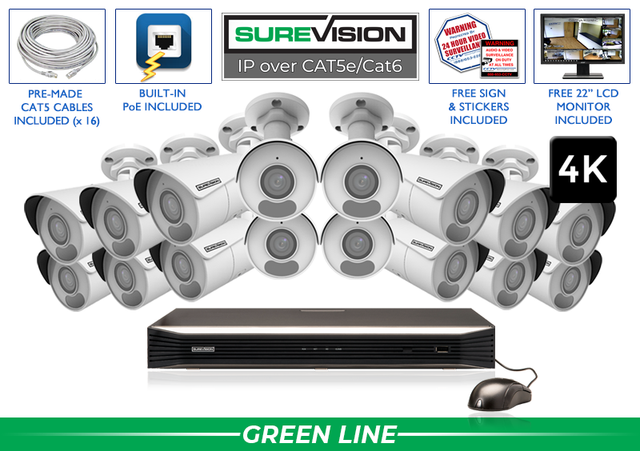
A 4K security camera system is a video surveillance system that uses one or more 4K, typically 8MP, security cameras to capture ultra-high-definition video. Professional 4K IP systems commonly use wired PoE cameras connected to a compatible NVR for local video recording, playback and remote viewing. The result is a surveillance platform capable of recording substantially more image detail than lower-resolution systems when cameras are properly selected and positioned. In video surveillance, 4K generally refers to approximately 3840 × 2160 pixels, or about eight megapixels. That gives a 4K security camera roughly four times the pixel count of a standard 1080p 2MP camera. More pixels give the camera the ability to record more image information. This can be valuable when reviewing recorded footage, monitoring wider scenes or examining details within the image. However, higher resolution does not automatically guarantee better identification. The subject must still occupy enough pixels in the recorded image, and lighting, focus, lens choice and camera placement remain critical. The primary advantage of 4K surveillance is additional recorded image detail. That can be particularly useful in applications where video may need to be reviewed after an event or where a camera monitors a relatively large scene. Not necessarily. Resolution is important, but it is only one factor in surveillance performance. A properly positioned lower-resolution camera can sometimes provide more useful evidence than a poorly positioned 4K camera. Lens selection, field of view, lighting, nighttime conditions, mounting height, distance to the subject and camera angle all matter. The objective should be to design the surveillance view correctly first and then choose an appropriate resolution. 4K security cameras can be used in many environments, but they are especially attractive when recorded detail matters or cameras need to monitor larger scenes. 4K describes the camera's resolution, not its physical design. Professional 4K IP cameras are available in several styles, allowing different camera types to be used throughout the same compatible surveillance system. Bullet cameras provide directional surveillance and are popular for building perimeters, parking areas, entrances, driveways and outdoor locations. Dome cameras provide a compact appearance and work well in offices, stores, hallways, entrances and compatible indoor or outdoor installations. Turret-style cameras combine a compact design with flexible positioning and are useful for many general indoor and outdoor surveillance applications. PTZ cameras add motorized pan, tilt and optical zoom for larger surveillance areas. Resolution and available features vary by PTZ model. For professional installations, 4K PoE security cameras provide an excellent way to build a high-resolution wired surveillance system. PoE, or Power over Ethernet, allows compatible network equipment to provide camera power and network communication through Ethernet cabling. Unlike a Wi-Fi camera, a wired PoE security camera does not depend on the property's wireless signal to transmit its video to the surveillance network. That makes PoE particularly attractive for permanent multi-camera installations. A professional PoE system can combine 4K cameras with other compatible IP camera resolutions and styles when every location does not require the same camera. That flexibility is one reason IP surveillance works well for customized security camera systems. High-resolution surveillance creates a continuous flow of video data. For permanent business, commercial and home installations, a wired connection provides a strong foundation for moving that video between compatible IP cameras and the surveillance network. Wireless cameras can be convenient in locations where running network cable is impractical, but Wi-Fi performance depends on signal strength, interference, network congestion and the building environment. For that reason, CCTV Security Pros primarily focuses on professional wired security cameras and PoE security camera systems for customers seeking permanent surveillance installations. A surveillance system must often perform when the property is least occupied: at night. Many professional 4K security cameras therefore include infrared illumination or other low-light capabilities for nighttime surveillance. Selected camera models may provide enhanced low-light or color night viewing under appropriate lighting conditions. Nighttime capability varies by model, and the installation environment has a major effect on performance. Walls, reflective surfaces, landscaping, vehicle headlights, exterior lighting, camera angle and the distance to the subject can all influence nighttime video. For that reason, choosing a 4K camera based only on its resolution can overlook one of the most important parts of 24-hour surveillance. Outdoor 4K security cameras can provide high-resolution coverage of driveways, parking lots, entrances, loading docks, yards, warehouses and building perimeters. The camera selected should be appropriately rated for the environment where it will be installed. For exterior surveillance, consider more than resolution. Weather exposure, mounting location, night illumination, lens, viewing distance and the amount of scene detail required should all influence camera selection. A professional 4K IP security camera system requires an NVR capable of supporting the cameras, resolution and total video workload of the system. The recorder becomes the central location for video storage, playback and system management. Recorder selection should consider channel count, supported camera resolution, incoming bandwidth, hard-drive capacity, display capabilities and future expansion. Simply choosing an NVR with the correct number of channels does not necessarily mean it is the right recorder for every 4K configuration. If you expect to add cameras later, selecting additional available channels from the beginning can make expansion much easier. 4K security cameras generally require more storage than comparable lower-resolution cameras because more video information must be recorded. However, there is no single hard-drive size that is correct for every 4K camera. The amount of storage required depends on several factors: A properly sized NVR and surveillance-grade hard drive should be selected around the actual recording plan. Systems requiring long retention periods or many high-resolution cameras may need substantially more storage than smaller installations. Video compression is especially important in high-resolution surveillance. Modern compatible cameras and recorders may use H.265 compression to reduce the amount of data required to store video compared with older compression methods, depending on the scene and configuration. Efficient compression can help make 4K recording more practical, but storage should still be calculated around the specific camera count, recording settings and desired retention period rather than assuming a fixed amount of storage per camera. Compatible professional security camera systems can provide remote viewing from phones, tablets and computers. The cameras continue recording locally to the NVR while authorized users can access live or recorded surveillance remotely when the system has the required network connection and is properly configured. Remote viewing does not mean all recorded video must be stored in the cloud. A local NVR-based system can keep primary surveillance recordings at the property while still providing convenient remote access. Businesses can use 4K security cameras to monitor entrances, offices, sales floors, warehouses, inventory areas, loading docks, parking lots and building perimeters. A professional NVR provides centralized recording for multiple cameras. Homeowners can use professional 4K cameras around entrances, driveways, garages, yards and other important areas. Wired local recording provides a different approach from relying entirely on individual consumer cloud cameras. The best security camera resolution depends on the surveillance objective. 4K provides the greatest pixel count of these common resolutions, but not every camera position necessarily requires 4K. A camera covering a small, controlled area may perform its job well at 4MP, while a camera monitoring a larger scene may benefit from the additional detail available from 4K. Professional IP systems can often combine compatible camera types and resolutions, allowing resolution to be selected by location. This is one advantage of building a customized surveillance system rather than choosing a package solely because every camera has the same specification. Start with the property and surveillance objectives rather than simply choosing the camera with the largest specification number. A professional 4K security camera system should be designed around what each camera needs to see. The number of cameras should be determined by the number of surveillance views required—not simply by square footage. Each entrance, driveway, parking area, hallway, loading area or other important location may require its own camera angle. Higher resolution can provide more recorded detail within a camera's view, but it does not eliminate walls, corners, obstructions or blind spots. A properly designed 4K system still requires enough cameras to provide the necessary views of the property. A professional NVR-based 4K security camera system can record surveillance video locally without requiring a monthly cloud-storage subscription for standard recording. Video is stored on hard drives installed in the recorder, with storage capacity selected around the needs of the system. This gives businesses and homeowners control over their primary surveillance recordings while compatible systems can still provide remote viewing when needed. In surveillance, an approximately 8MP camera with a resolution around 3840 × 2160 is generally described as 4K or 4K UHD. They can be especially valuable where high recorded detail, wider scenes or closer review of recorded footage is important. Whether every camera needs 4K depends on the individual surveillance location. Generally yes. Higher-resolution video usually requires more storage than comparable lower-resolution video. Actual storage usage depends on bitrate, frame rate, compression, recording mode, scene activity and other settings. Yes. Many professional 4K security cameras provide infrared or other low-light capabilities. Exact night-vision performance varies by camera model and environment. A properly configured local NVR-based system does not normally require internet access simply to record video locally. Internet connectivity is generally required for off-site remote viewing and other online functions. Yes. Compatible 4K IP security cameras can use Power over Ethernet, allowing network communication and camera power through Ethernet infrastructure. Often yes when the specific cameras and NVR are compatible and the recorder supports the required resolutions and total system workload. Compatibility should be confirmed before purchasing. High resolution can help with recorded detail, but resolution alone does not make a camera an LPR camera. Reliable license-plate capture depends on factors such as vehicle speed, distance, camera angle, lens and lighting. Specialized license plate recognition cameras are designed for these applications. Compare professional surveillance cameras, recorders and complete systems or learn more about designing the right security camera system for your property.What Is a 4K Security Camera System?
What Does 4K Mean in a Security Camera System?
Why Choose a 4K Security Camera System?
Is 4K Always Better for Security Cameras?
Where Are 4K Security Camera Systems Most Useful?
Monitor vehicles, pedestrian activity and larger outdoor scenes.
Record higher-detail video at important access points.
Monitor aisles, loading areas, inventory and large interior spaces.
Provide detailed coverage of entrances, registers and merchandise areas.
Build high-resolution surveillance around buildings and property perimeters.
Monitor driveways, entrances, garages, yards and other important areas.Types of 4K Security Cameras
4K Bullet Security Cameras
4K Dome Security Cameras
4K Turret Cameras
PTZ Security Cameras
4K PoE Security Cameras & Wired 4K Systems
Wired vs Wireless 4K Security Camera Systems
4K Security Cameras & Night Vision
Outdoor 4K Security Camera Systems
Choosing an NVR for 4K Security Cameras
How Much Storage Does a 4K Security Camera System Need?
4K Video Compression & H.265
Can You View 4K Security Cameras Remotely?
4K Security Camera Systems for Business & Home
Business 4K Security Camera Systems
Home 4K Security Camera Systems
4K vs 4MP vs 1080p Security Cameras
How to Choose the Best 4K Security Camera System
Entrances, exits, parking, inventory, driveways and other important locations.
Consider how far important subjects will be from each camera.
Bullet, dome, turret, PTZ or specialty cameras may fit different locations.
Consider both daytime and nighttime surveillance conditions.
Account for camera channels, resolution, bandwidth and expansion.
Base storage on camera count, recording settings and retention goals.How Many 4K Security Cameras Do You Need?
4K Security Camera Systems with No Required Monthly Fees
Frequently Asked Questions About 4K Security Camera Systems
Is an 8MP security camera the same as 4K?
Are 4K security cameras worth it?
Do 4K security cameras use more storage?
Can 4K security cameras record at night?
Do 4K security cameras need internet?
Can 4K cameras use PoE?
Can I mix 4K and 4MP cameras on the same NVR?
Are 4K cameras good for license plates?
Explore 4K Cameras, IP Cameras, NVRs & Security Camera Systems
Quick Answer
1080p / 2MP Approximately 1920 × 1080 pixels. Traditional Full HD surveillance resolution.
4MP Higher resolution than 1080p and a popular professional surveillance option.
4K / 8MP Approximately 3840 × 2160 pixels for substantially greater recorded image detail.
More Recorded Detail Higher pixel density can preserve more visual information than lower-resolution cameras.
Better Digital Review Higher-resolution recordings generally provide more information when digitally enlarging part of a recorded image.
Useful for Wide Scenes 4K can be valuable when a camera must record a wider surveillance area while retaining useful detail.
Modern System Design 4K provides a strong resolution platform for modern professional IP surveillance systems.
Parking Areas
Entrances & Exits
Warehouses
Retail Stores
Commercial Properties
Homes
Choosing the Camera
System Planning
1. Identify Critical Areas
2. Determine Viewing Distance
3. Choose the Camera Style
4. Evaluate Lighting
5. Size the NVR
6. Calculate Storage
4K Security Camera FAQ
Continue Your Research