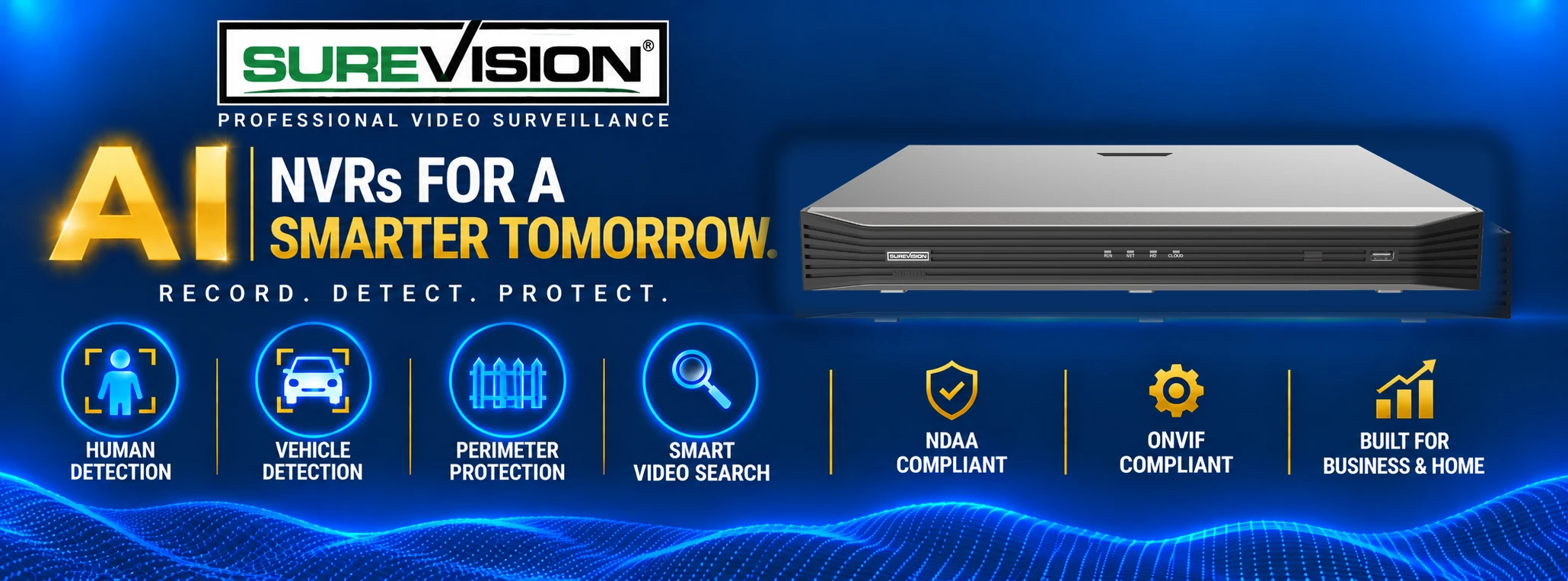
Network Video Recorders
SureVision Professional IP Recording
SureVision Network Video Recorders for IP & PoE Cameras
Shop professional SureVision network video recorders for compatible IP and PoE security cameras. An NVR centralizes local recording, live viewing, playback, exports, supported smart alerts and remote access while keeping surveillance footage under your control without required monthly cloud-storage fees.
Choose 4-, 8-, 16-, 32-, 64- or 128-channel capacity based on the cameras installed now and future expansion. SureVision NVRs are configured with brand-new surveillance-grade hard drives before shipment, so professional local storage is installed and ready for recording.
Match the recorder to camera resolution, incoming bandwidth, PoE requirements, retention goals and supported smart features. This creates a dependable recording platform for homes, businesses, schools, warehouses and enterprise properties.
Professional IP Video Recording Guide
Choose the Right NVR for Your IP Security Cameras
A network video recorder, commonly called an NVR, is the recording and management center of a wired IP camera system. It receives digital video from compatible network cameras, stores footage on local hard drives and provides one place to monitor live video, search events, play recordings and export clips.
The correct recorder must support more than the camera count. Compatibility, incoming bandwidth, recording resolution, PoE capacity, hard-drive bays, retention requirements, smart features and future expansion all influence which SureVision NVR fits the project.
What Does a Network Video Recorder Do?
A professional IP camera NVR combines recording, storage, playback, camera management and supported remote access in one central device.
Records IP Camera Video
Record compatible cameras continuously, on schedules or when supported motion and smart-event rules are triggered.
Stores Footage Locally
Keep recordings on surveillance hard drives controlled at the property instead of depending on required cloud storage.
Searches & Exports Events
Review timelines or supported event searches and export important video for documentation, investigation or evidence.
Supports Remote Viewing
Access compatible live cameras and recordings from supported phones, tablets and computers when properly configured.
Standard NVR vs. PoE NVR
NVR is the general term for a recorder that manages compatible network cameras. A PoE NVR includes Power over Ethernet ports that can supply supported power and network connectivity to compatible cameras over Ethernet. Direct PoE ports can simplify a smaller wired installation because each camera can connect to the recorder with one CAT5e or CAT6 cable.
Larger or distributed systems may connect cameras through separate PoE switches instead of running every cable directly to the NVR. This can help organize cameras across distant areas or multiple buildings. The proper design depends on the recorder, number of cameras, network layout, cable distances, PoE budget and incoming video bandwidth.
Confirm whether the selected NVR includes built-in PoE ports and whether those ports support the quantity and power requirements of the planned cameras. A channel count alone does not describe the complete connection capacity.
How Many NVR Channels Do You Need?
Each recorder channel supports one compatible camera. Choose enough channels for the current installation and realistic expansion, then verify recorder bandwidth and storage for the complete design.
4- and 8-Channel NVRs
Focused coverage for homes, offices, storefronts and smaller properties. Extra channels can make later additions easier.
16- and 32-Channel NVRs
Broader recording capacity for businesses, warehouses, schools, parking areas and multi-zone properties.
64- and 128-Channel NVRs
Enterprise recording for large facilities, campuses and extensive surveillance networks requiring detailed planning.
An eight-camera installation may benefit from a 16-channel recorder when expansion is likely. For large sites, also evaluate drive bays, RAID options where available, network bandwidth, remote users and how cameras are distributed across the property.
Camera Compatibility, Resolution and Recording Bandwidth
Before choosing an NVR for IP cameras, confirm support for the planned camera models, protocols, resolution and features. ONVIF can support broader interoperability, but it does not guarantee that every camera function will operate on every recorder. Native matching usually provides the most complete feature support.
4MP cameras can balance recorded detail, bandwidth and storage for everyday professional surveillance. 8MP or 4K cameras provide more recorded pixels for priority views but create larger video streams and generally require more storage.
Recording bandwidth is the total incoming video data the NVR can process. Camera count, resolution, frame rate, compression, bitrate, audio and scene activity affect the combined load. Confirm both per-camera compatibility and the recorder’s total incoming bandwidth instead of relying on channel count alone.
NVR Hard Drives and Video Retention
SureVision recorders are configured with brand-new surveillance-grade hard drives before shipment. Surveillance drives are designed for continuous video workloads, while the selected capacity determines how long footage can remain before the NVR begins overwriting the oldest recordings.
Retention depends on camera quantity, resolution, bitrate, compression, frame rate, scene activity and recording schedule. Continuous recording usually uses more storage than motion or event recording, although busy scenes can still generate frequent events. Define whether the property needs 7, 14, 30, 60 or more days before selecting capacity.
Larger recorders may support multiple hard-drive bays or storage expansion. Use the NVR storage calculator to estimate capacity, or browse compatible surveillance hard drives.
Recording Modes, Smart Events and Remote Access
Continuous recording provides the most complete timeline for critical entrances, cash areas, loading zones and other high-priority views. Scheduled recording can follow operating hours, while motion or smart-event recording may extend retention in lower-activity areas. Many professional systems combine recording modes by camera.
Compatible cameras and NVRs may support human and vehicle detection, intrusion areas, line crossing, audio events or other intelligent search tools. Available functions vary by equipment and configuration. Smart features work best when the target is clear in the image and the detection area is set correctly.
Local recording can continue without internet service. Internet access is required for off-site viewing, mobile notifications and other remote functions. Plan authorized users, passwords, permissions, exports and network security before giving remote access to the system.
Do You Need an NVR or a DVR?
Camera technology and wiring determine the recorder type. Use a compatible NVR for IP or PoE security cameras that communicate over Ethernet networks. Use a compatible DVR for HD-over-coax cameras connected through coaxial cabling and BNC video connections.
An NVR is usually the preferred foundation for a new SureVision wired IP installation. A DVR can be the practical choice when upgrading a property that already has suitable coax cable. Compare HD CCTV DVR recorders or browse all security camera recorders.
Pair Your NVR with SureVision Cameras or a Complete System
When expanding an existing recorder, choose individual SureVision IP cameras that match its supported resolution, protocol, PoE and feature requirements. A compatible NVR can combine bullet, turret, dome, varifocal, PTZ and specialty cameras for different views around the property.
For a new installation, a complete SureVision PoE IP security camera system brings compatible cameras, NVR recording and local storage together. This can simplify initial equipment matching while still allowing supported camera styles and storage to be customized.
NVR Installation and Network Planning
Place the NVR in a secure, ventilated and climate-controlled location with dependable power. The recorder should be accessible for authorized service but protected from easy disconnection, theft, excessive heat, moisture and dust.
Map camera connections, PoE switches, uplinks and internet access before installation. Confirm cable distances, network addressing, bandwidth and PoE power requirements. Label connections and document recorder settings so future maintenance and expansion are easier.
For larger businesses, schools and government properties, define retention, user permissions, cybersecurity expectations and export procedures before deployment. Verify any NDAA, UL, ONVIF or procurement requirement against the selected recorder and complete configuration rather than assuming every feature applies universally.
Six NVR Decisions to Make Before Ordering
Network Video Recorder Questions
What is an NVR for IP cameras?
It is a network video recorder that receives, records and manages digital video from compatible IP cameras while providing local storage, playback and supported remote access.
Does every NVR have PoE ports?
No. Some recorders include built-in PoE ports, while others receive camera streams through separate network switches. Confirm the connection design for the selected model.
Can an NVR record 4K cameras?
Compatible 4K NVRs can record supported 4K IP cameras. Verify resolution, decoding, incoming bandwidth, storage and camera compatibility.
Will an NVR record without internet?
Local recording does not require internet service. Internet access is needed for off-site viewing, mobile alerts and other remote functions.
Do SureVision NVRs require monthly fees?
No required monthly subscription is needed for standard local recording and compatible remote-viewing tools. Internet and optional third-party services are separate.
Can different camera styles use one NVR?
Yes, when the cameras and their required features are compatible. One NVR can manage different housings and lenses selected for different views.
How much NVR storage is needed?
Calculate storage from camera count, resolution, bitrate, frame rate, compression, recording schedule, scene activity and required retention days.
Can CCTV Security Pros help select an NVR?
Yes. Provide camera models, quantity, desired retention and future plans so the team can help match recorder channels, compatibility and storage.
Real Help Before and After the Sale
Get the Right NVR, Cameras and Storage
Tell our U.S.-based team what cameras you own, how many channels you need and how long footage should remain available. We can help match a SureVision recorder and storage configuration to your property.