

Hidden Business Security Cameras: Professional Guide
Jul 30, 2026
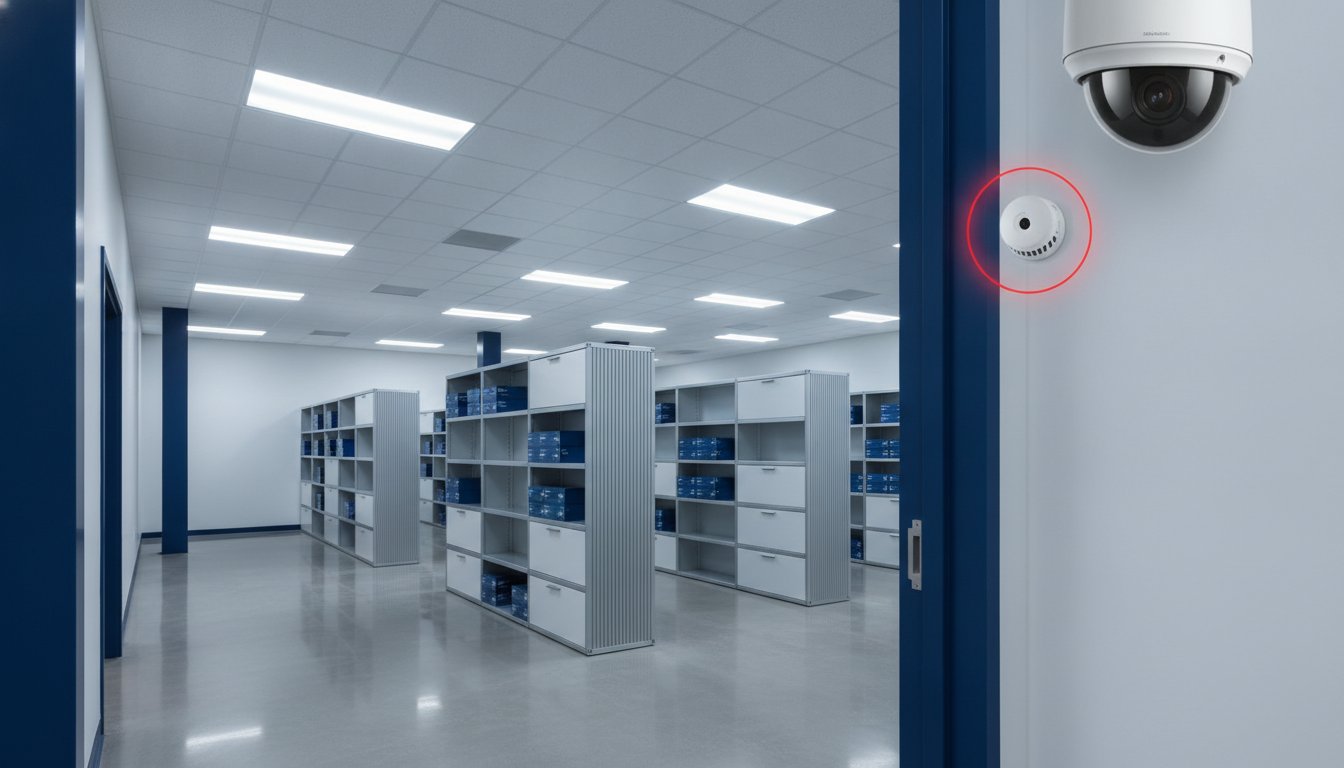
What if your most effective security tool was the one that nobody, including intruders or dishonest staff, ever realized was there? While visible systems provide a deterrent, they often leave blind spots that savvy shoplifters and internal actors can easily exploit. You've likely realized that standard protection isn't always enough, especially when U.S. employers lose an estimated $400 billion annually to time theft. High-quality hidden security cameras for business offer a tactical advantage, but only if they move beyond the low-resolution gadgets found on consumer sites.
You need a system that delivers professional-grade clarity without the burden of monthly monitoring fees or vulnerable cloud storage. This guide explores how to integrate covert surveillance into your existing infrastructure to protect high-value zones and sensitive areas effectively. We'll walk you through the legal considerations of workplace monitoring, the technical specifications required for courtroom-ready evidence, and how to maintain total control over your data with local NVR recording.
Key Takeaways
- Learn how a hybrid strategy uses visible cameras as a deterrent while hidden units act as a critical fail-safe for loss prevention.
- Identify the professional technical standards, including 4K resolution and PoE installation, that ensure your footage is clear and reliable.
- Navigate the legal complexities of implementing hidden security cameras for business to maintain compliance with workplace privacy expectations.
- Maximize your return on investment by choosing local NVR storage over restrictive, monthly cloud-based subscription models.
- Ensure long-term operational success with hardware that includes professional warranties and dedicated technical support.
The Strategic Role of Hidden Security Cameras in Business Operations
Covert surveillance in a commercial setting is a specialized strategy focused on discreet monitoring for loss prevention. It provides a unique psychological advantage because it captures behavior as it naturally occurs, uninfluenced by the presence of visible hardware. To understand the broader history and standard applications of these devices, you can consult this Hidden camera overview. For a business owner, the goal isn't just to record; it's to secure assets without signaling to potential intruders exactly where the surveillance coverage begins and ends.
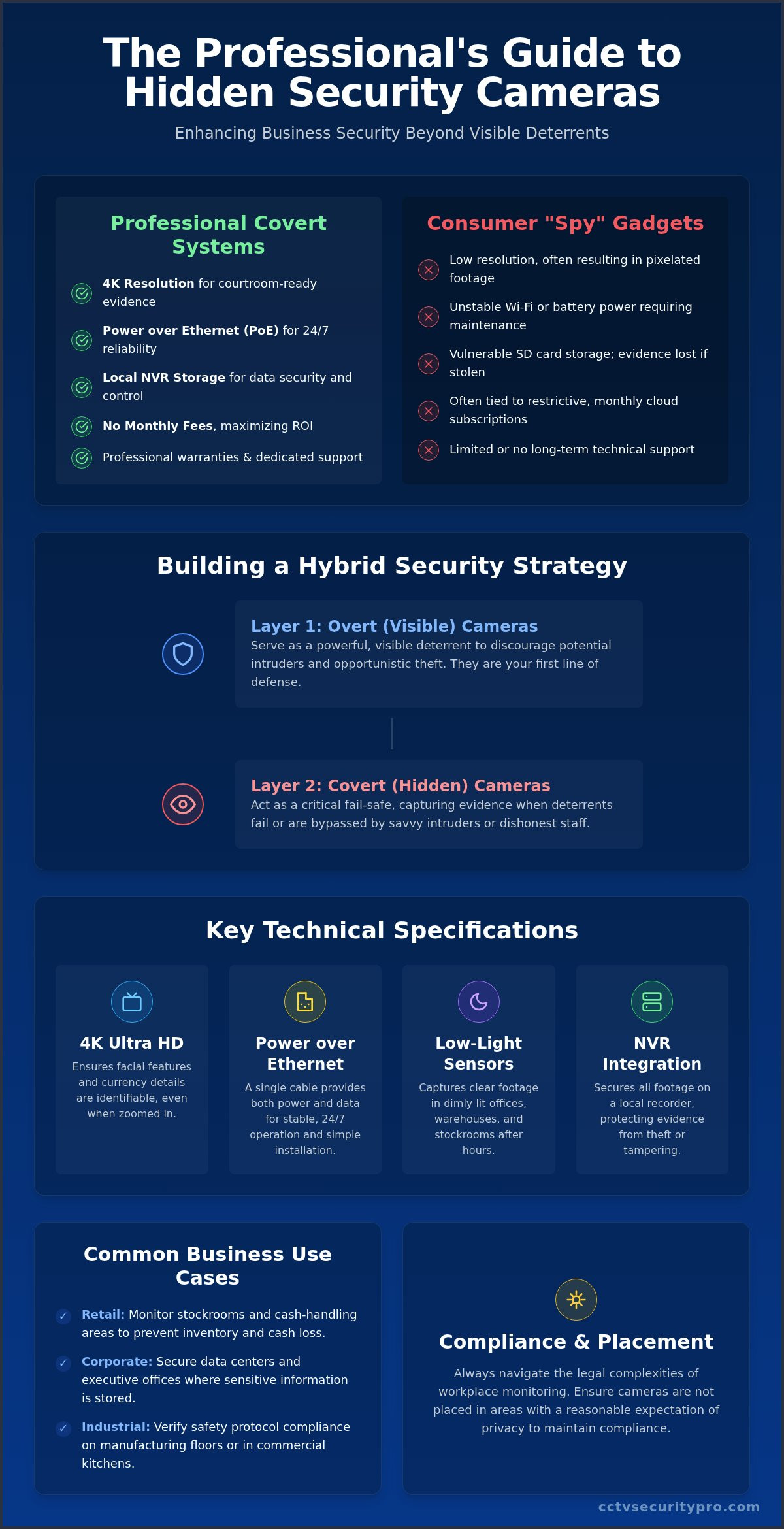
The distinction between consumer "spy gadgets" and professional hidden security cameras for business is significant. While low-end items often rely on unstable Wi-Fi or battery-powered shells, professional systems are engineered for 24/7 reliability. These cameras integrate seamlessly with a centralized Network Video Recorder (NVR), ensuring that every second of footage is stored locally and securely. This technical integration shifts your security posture from reactive to proactive. You aren't just checking tapes after a loss occurs; you're building an invisible infrastructure that monitors high-stakes environments with professional precision.
Why Businesses Choose Covert Over Overt Surveillance
Visible dome or bullet cameras serve as excellent deterrents, but they are also targets for tampering. If an intruder or a dishonest employee knows exactly where a camera is located, they can easily avoid its field of view or physically disable the lens. Covert cameras eliminate this risk by keeping their location unknown to everyone but authorized management. Additionally, using discreet monitoring helps maintain a welcoming atmosphere for customers and staff. It prevents the "police state" feeling that can arise when too many visible lenses are present, allowing for more authentic interactions in retail and hospitality settings.
Common Business Use Cases for Hidden Cameras
The application of these systems varies depending on the specific vulnerabilities of a facility. In retail environments, they are most effective in stockrooms and cash-handling areas where high-value inventory is processed. In corporate offices, they monitor sensitive data centers or executive suites where proprietary information is stored. Industrial settings also benefit from discreet placement to verify that safety protocols are being followed in kitchens or on manufacturing floors. These diverse use cases highlight how hidden security cameras for business act as a critical fail-safe when visible security measures reach their limits.
Technical Specifications: What Defines Professional-Grade Covert Cameras?
Professional-grade surveillance requires more than just a small lens; it demands high-fidelity imaging and stable connectivity. When you select hidden security cameras for business, resolution is the first metric to evaluate. While 1080p provides a solid baseline for general monitoring, 4K resolution is necessary when you need to identify small denominations of currency or specific facial features in a crowded retail space. High resolution ensures that digital zoom doesn't result in pixelated, useless footage during a forensic review. Clear evidence is the difference between a closed case and an unresolved loss.
Power over Ethernet (PoE) is the standard for professional installations. It allows a single Cat5e or Cat6 cable to provide both power and data. This simplifies the process of hiding wires behind walls or above ceiling tiles. Unlike battery-powered units that require frequent maintenance, PoE cameras offer 24/7 uptime. Modern covert housings also utilize specialized low-light sensors. Since hidden cameras are often placed inside objects like smoke detectors or motion sensors, they must be capable of recording in dimly lit offices or warehouses after hours. Wide-angle lenses are typically integrated into these housings to ensure a single device covers an entire room without leaving blind spots.
The Importance of Professional NVR Integration
Many entry-level cameras record to internal SD cards. In a commercial environment, this is a significant risk. If the camera is discovered or stolen, your evidence is gone. A professional system connects your covert devices directly to a Network Video Recorder (NVR). This allows you to sync your hidden units with your primary 8 or 16-camera IP systems, creating a unified security dashboard. High-bitrate recording on an NVR ensures that the video stream remains fluid and detailed, providing the high-quality evidence required for insurance claims or legal proceedings.
Form Factors: Smoke Detectors, PIR Sensors, and Beyond
Choosing the right housing is about matching your existing infrastructure. If your office already has smoke detectors every ten feet, adding a camera-equipped smoke detector is the logical choice. The "hidden in plain sight" philosophy works best when the device looks like a functional part of the building. As employers increasingly use technology to surveil employees for safety and productivity, choosing a housing that blends in is vital. Ensure the lens has a clear line of sight. Even a small piece of plastic from the housing can obstruct the wide-angle view, rendering the camera ineffective.
Covert vs. Overt Surveillance: Building a Hybrid Security Strategy
Effective security doesn't require choosing between visible or hidden hardware. The most robust commercial installations utilize a hybrid approach. While visible dome cameras act as a primary deterrent, hidden security cameras for business serve as a critical fail-safe. This layering ensures that even if an intruder identifies and avoids your overt monitoring, they remain captured by your covert devices. It's a tactical method of 'guiding' a suspect's movement. When a person sees a visible camera, they instinctively turn their head or adjust their path, often positioning themselves perfectly for a hidden lens placed at eye level.
The cost-benefit analysis of this hybrid model is clear. Visible cameras reduce crimes of opportunity, while hidden units protect against more sophisticated threats, including internal theft. To legally monitor a worker's performance or secure high-value stockrooms, you must understand the balance between deterrence and investigation. Investing in both types of hardware creates a comprehensive net that standard systems simply can't match. This strategy provides peace of mind by ensuring that your security doesn't rely on a single, easily identifiable point of failure.
The Deterrence Factor of Overt Cameras
Overt cameras, such as vandal-proof dome models, are essential for perimeter and entrance security. They announce to the public that your facility is under constant watch. This visibility significantly reduces 'crimes of opportunity' where a lack of monitoring might tempt a shoplifter or trespasser. By placing these in obvious locations, you set a high bar for entry. Even if an intruder is bold enough to proceed, the presence of visible cameras often forces them into predictable behaviors that your hidden systems are specifically positioned to record. You aren't just watching; you're actively managing the risk profile of your entire property.
The Investigative Power of Covert Cameras
While overt cameras stop some, they don't stop everyone. This is where the investigative power of hidden security cameras for business becomes indispensable. They capture authentic, high-quality footage of suspects who believe they've successfully bypassed your security. This is particularly vital for identifying 'insider threats' like employees or contractors who know the location of every visible camera and have learned to work around them. When you have high-resolution, covert footage, you possess the 'smoking gun' evidence needed for insurance claims or legal prosecution. It removes the ambiguity that often plagues investigations based solely on visible, easily avoidable equipment.
Compliance and Placement: Navigating the Legalities of Hidden Monitoring
"Is it legal to have hidden cameras in my business?" is the most common question we receive. The short answer is yes, provided the surveillance serves a legitimate business purpose and respects the legal threshold of a "Reasonable Expectation of Privacy." When you deploy hidden security cameras for business, you must ensure they are placed in areas where employees and customers don't have a high expectation of personal privacy. This typically includes sales floors, stockrooms, and entryways where business activities are conducted openly.
However, certain areas are strictly off-limits. Restrooms, locker rooms, and changing areas are universal "No-Go Zones" where secret recording is illegal in all states. You must also be cautious with audio. While video surveillance is generally permissible in common areas, audio recording is governed by much stricter wiretapping laws. Eleven states, including California, Florida, and Illinois, require all-party consent for audio capture. If your covert housing includes a microphone, it's often safer to disable the audio feature unless you've confirmed compliance with local statutes. We always recommend consulting with legal counsel to draft a specific corporate policy before activation.
Best Practices for Ethical Employee Monitoring
Transparency is your best defense against liability. You can legally monitor a workspace by including a general surveillance disclosure in your employee handbook. You don't need to reveal the exact locations of your covert devices; simply stating that the premises are subject to video monitoring for safety and loss prevention is often sufficient. It's also vital to establish strict access controls. Only a few high-level managers should have the credentials to view covert footage on your NVR. This prevents the misuse of data and reinforces that the system is a professional tool for asset protection.
Optimizing Camera Placement for Maximum Coverage
Technical placement is just as important as legal compliance. For effective facial recognition, covert housings should be mounted as close to eye level as possible, typically between five and six feet. If you place a camera too high, you'll only capture the tops of heads. You should also watch for "backlighting" from large windows or bright entryways. Strong light behind a subject can turn their face into a dark silhouette, rendering the footage useless. By ensuring overlapping fields of view between your hidden units and your professional IP camera systems, you can eliminate blind spots and create a seamless wall of protection.
Investing in Professional Covert Systems without Recurring Monthly Fees
Many consumer-grade security brands lure business owners with low upfront costs, only to hide the true expense in mandatory monthly subscriptions. Professional hardware offers a different path. By choosing a one-time equipment purchase, you eliminate recurring fees that can drain your operational budget over time. This model provides a superior return on investment. You own the hardware and, perhaps more importantly, you own the data. Local NVR storage is inherently more secure than cloud-based systems because your footage doesn't traverse third-party servers. It stays on your premises, under your physical control, protected from the vulnerabilities of external data breaches.
The value of your system extends beyond the hardware itself. CCTV Security Pros supports businesses with lifetime USA-based technical support, positioning us as a stable partner in your security strategy. If you encounter a configuration challenge or need assistance with system troubleshooting, you speak with an expert who understands the nuances of professional installations. This level of support, combined with a 3-year warranty on all professional hardware, ensures that your hidden security cameras for business remain operational for the long term. You aren't just buying a camera; you're investing in a reliable, high-performance security infrastructure.
Remote Viewing Without the Subscription
Monitoring your facility shouldn't come with a monthly bill. You can access your hidden camera feeds directly from a smartphone or tablet with no recurring fees. This is achieved through secure, encrypted remote access that connects you directly to your NVR. If you manage multiple locations, such as several retail branches or warehouse sites, you can integrate all feeds into a single, unified interface. This centralized management allows you to maintain total oversight of your business assets from anywhere in the world without sacrificing data privacy or incurring additional costs.
Why a 3-Year Warranty Matters for Covert Hardware
Covert hardware faces unique environmental challenges. Because these cameras are often placed inside heat-retaining housings like smoke detectors or motion sensors, they must be engineered for durability and thermal management. Cheap "spy" cameras often fail in these tight spaces due to poor heat dissipation. Professional-grade hardware is built to withstand these conditions, providing the longevity required for commercial use. A 3-year warranty provides the reassurance that your equipment is rugged enough for 24/7 operation. If you are ready to secure your facility with reliable, discreet technology, you can explore our professional hidden security cameras for business to find the right fit for your specific environment.
Secure Your Business with Tactical Precision
Implementing a hybrid strategy that combines visible deterrence with professional-grade covert monitoring is the most effective way to protect your commercial assets. By prioritizing high-resolution hardware and local NVR storage, you eliminate the recurring costs and security vulnerabilities associated with cloud-based consumer systems. You now have the technical and legal framework to ensure your facility remains monitored with forensic-level clarity. This transition from reactive recording to proactive asset protection is a critical step for any modern operation.
Choosing the right hidden security cameras for business is an investment in long-term operational stability. Similarly, protecting your facility from environmental hazards is crucial; for business owners in need of remediation insights, Mold Pros Phoenix provides valuable data on inspection and removal costs. CCTV Security Pros has supported over 70,000 satisfied customers by providing rugged, reliable hardware backed by a 3-year warranty and lifetime USA-based technical support. You don't have to settle for low-quality gadgets or restrictive monthly subscriptions to achieve absolute peace of mind. Our team is ready to help you configure a system that meets your specific environmental needs.
Take control of your facility's security today. Shop Professional Hidden Cameras with No Monthly Fees and experience the difference that professional-grade surveillance makes for your bottom line. We're here to help you secure what matters most.
Frequently Asked Questions
Are hidden security cameras legal for use in a business environment?
Hidden cameras are legal for business use when they are placed in areas where employees and customers don't have a reasonable expectation of privacy. This includes sales floors, warehouses, and lobbies. You must avoid restrooms, locker rooms, and changing areas to remain compliant with privacy laws. Always check your state's specific regulations regarding audio recording, as these are often much stricter than video surveillance rules.
Do hidden cameras require a separate NVR or can they work with my current system?
Professional hidden cameras can integrate with your current IP system if it uses industry-standard protocols. Most of our covert models are designed to work seamlessly with our 8, 16, or 32-camera NVRs. This centralized recording ensures all your footage, both overt and covert, is stored in one secure location for easy management and forensic review during an investigation.
Can hidden cameras record in total darkness?
Many hidden security cameras for business are equipped with infrared (IR) technology to record in complete darkness. To remain truly covert, these models often use 940nm LEDs, which don't emit the faint red glow seen on standard cameras. This allows for high-clearance black-and-white footage in unlit stockrooms or offices without alerting an intruder to the camera's presence or location.
What is the best location to hide a security camera in a retail store?
The most effective location in a retail store is at eye level near high-value inventory or point-of-sale terminals. While ceiling-mounted smoke detector cameras offer a wide overview, a PIR sensor camera mounted five to six feet high is superior for facial recognition. Placing cameras near exits also ensures you capture a clear image of a suspect's face as they leave the premises.
Do I need to pay a monthly fee to view my hidden cameras remotely?
You don't need to pay a monthly fee to view your footage remotely when using our professional systems. Remote viewing is included with the purchase of your NVR and cameras. By storing your video locally on a hard drive rather than a cloud server, you avoid recurring subscription costs while maintaining faster, more secure access to your data through our dedicated mobile app.
How do I power a hidden camera without visible wires?
The most reliable way to power a hidden camera without visible wires is through Power over Ethernet (PoE). This technology sends both data and power through a single Cat5e or Cat6 cable. By running this cable through the ceiling or behind drywall, you can power your covert devices indefinitely. This eliminates the need for batteries, which require frequent maintenance and can fail at critical moments.
Can hidden cameras record audio in a business setting?
While many covert cameras have audio capabilities, recording sound in a business setting is highly regulated. Federal and state laws generally require at least one party to consent to being recorded. In 11 states, including Florida and California, all parties must consent. Because of these legal risks, many businesses choose to disable audio and focus strictly on capturing high-resolution video evidence.
What resolution is recommended for professional covert surveillance?
We recommend a minimum resolution of 1080p for hidden security cameras for business, though 4K is the current professional standard. Higher resolution is vital for covert surveillance because you often need to digitally zoom in on small details, such as currency denominations or specific facial features. Professional-grade sensors ensure that your footage remains sharp and useful for law enforcement or insurance investigations.