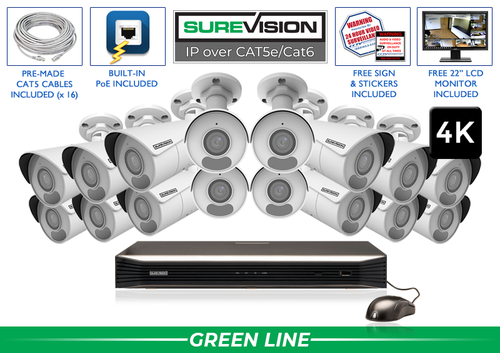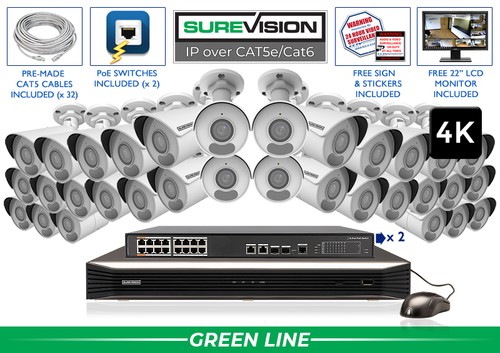
Professional property surveillance since 2008 Plan clear views of arrivals, shared routes, deliveries and staff access with professional wired cameras and local NVR recording. A healthcare facility needs a camera plan that supports its daily operations. Focus on the entrances, shared routes, deliveries, parking and controlled access points that the facility has approved for security coverage. Build a useful recorded sequence while keeping clinical care, private conversations and sensitive information outside the intended camera job. Complete 4K camera systems Start with a value-focused SureVision 4K PoE kit, then match the camera positions to your layout. These complete systems bring cameras, local recording, storage and camera cables together. Choose cable lengths and storage for the job when ordering. Need different camera styles or a tighter view? Our team can help customize the kit around your business. Bring the facility lead, operations team and the people responsible for information privacy into the planning walk. Mark the entrances, shared corridors, receiving areas, parking routes and service doors approved for coverage. Give every proposed view an operational purpose, such as reviewing a delivery or following an entrance arrival. A security view should be framed for that purpose. Keep treatment spaces, changing areas and unnecessary views of documents or displays outside the intended coverage. Have the facility approve viewing positions and audio settings under its policies. A defined boundary makes the installation brief clearer and the completed system easier to manage. An entrance camera can show the approach and passage through the door. A separate shared-area view may help explain where movement continued. Check both during ordinary arrival periods, when people, mobility equipment, carts and open doors can change the sightlines across a reception area. Run a representative arrival and review the saved sequence from outside to the approved common route. Check bright windows and doorway lighting at different times of day. Adjust the angle so staff can understand the movement without making reception screens or registration paperwork the subject of the recording. Next step: Record a normal test event and review the saved result before final mounting. Trace a delivery from the service entrance through its approved staging point. Include the doorway, cart position and handoff area where those views are part of the facility plan. A camera aimed at an empty room may miss the actual handoff once cartons, shelving or an open door fill the scene. Test a delivery with the equipment normally used on site. Then check a staff entrance during a shift change. Use clear location names so an authorized reviewer can quickly distinguish Receiving Door, Service Corridor and Staff Entrance rather than searching through numbered channels without context. A fixed wide-angle camera can explain movement through a defined shared area or exterior approach. The featured 4K systems use fixed 2.8mm bullet cameras. Choose the location and framing for the job; a wider picture does not automatically provide a useful close view of a more distant access point. A motorized varifocal lens can refine a selected service door, delivery approach or parking-to-building route after mounting. For a larger exterior area, PTZ observation can complement fixed views of important paths. Review a person moving through the scene after dark before accepting the final mounting positions. Identify who needs live viewing, playback, exports or configuration access. Use individual authorized accounts and review permissions when responsibilities change. Place the recorder where the facility can control physical access and assign responsibility for account recovery, maintenance and storage checks. Use supported notifications for specific operational events, such as a restricted service approach during closed hours. Define who checks each alert and how the response transfers between shifts. Test the recording separately from phone notifications so a muted device is not mistaken for a recording failure. Next step: List the events, responsible users and notification hours, then test recording and alerts separately. Choose the recording-history target with the facility team according to its approved retention and incident-review process. Include weekends, closures and the typical delay before an issue is reported. Camera count, video settings, activity and the recording schedule affect retention. Count planned views and near-term additions before choosing recorder capacity. Check PoE ports and any separate switches as well as the channel count. Use the recording storage calculator, then confirm the history after the system has operated normally. SureVision systems combine local NVR recording with a free viewing app and no required monthly viewing fees. Internet at the property supports access from outside the site. A properly configured local camera network can record independently of that internet connection. Record an approved entrance arrival, a delivery handoff and a staff-access event. Have an authorized reviewer find and export each sequence using the permissions assigned to that role. Check remote access using cellular data, review recorded footage and open an exported clip on another device. Leave the owner with the account and recovery information needed to manage the system. A small clinic’s approved shared-area plan might start with an entrance, reception approach, service access and parking route. A larger facility may have separate wings, receiving areas and many controlled doors. Count those jobs first, then compare the featured 4, 8, 16 and 32-camera kits and the complete 2-to-64-camera range. For a new wired installation, start with matched SureVision IP cameras and an NVR. Choose storage, cable lengths, mounting accessories and powered connections together. CCTV Security Pros has supplied professional surveillance equipment since 2008, with a 3-year limited warranty and unlimited USA support for SureVision. Share a layout and your recording-history target for help selecting a complete system. Continue with the lens guide, PoE installation guide and recording storage calculator. Send your layout, important camera jobs and recording-history target. Our team can help match a complete system to the property.Healthcare Security Camera Systems: Useful Coverage for Shared Facility Areas
Popular Business Systems
In this guide
1. Choose the approved areas before choosing cameras
A practical coverage plan
Area
Camera job
Check during setup
Public entrance
Arrival and movement into the shared reception area
Test doorway glare, mobility equipment and busy arrival times.
Reception approach
Movement between arrival, waiting and approved common routes
Check that screens and registration documents are not the target.
Staff or service access
Use of an approved controlled doorway
Test carts, door swings and shift-change traffic.
Receiving area
Delivery arrival, staging and collection
Check stacked cartons and normal cart positions.
Parking and pedestrian approach
The route between vehicles and the building entrance
Test nighttime lighting and common obstructions.
2. Make arrival and reception views work together
3. Connect receiving, service routes and staff access
4. Select lenses for shared routes and exterior approaches
5. Give each user the access needed for their role
6. Choose NVR channels and recording history
7. Use free remote viewing and test the full workflow
8. Build a complete system around your layout
Look for the logo, expect the quality.Plan your healthcare camera system with the Pros
Free Viewing AppNo Monthly Viewing Fees3-Year WarrantyUnlimited USA Support