

8 Camera IP Systems: The Comprehensive Guide to Professional Surveillance in 2026
Jul 30, 2026
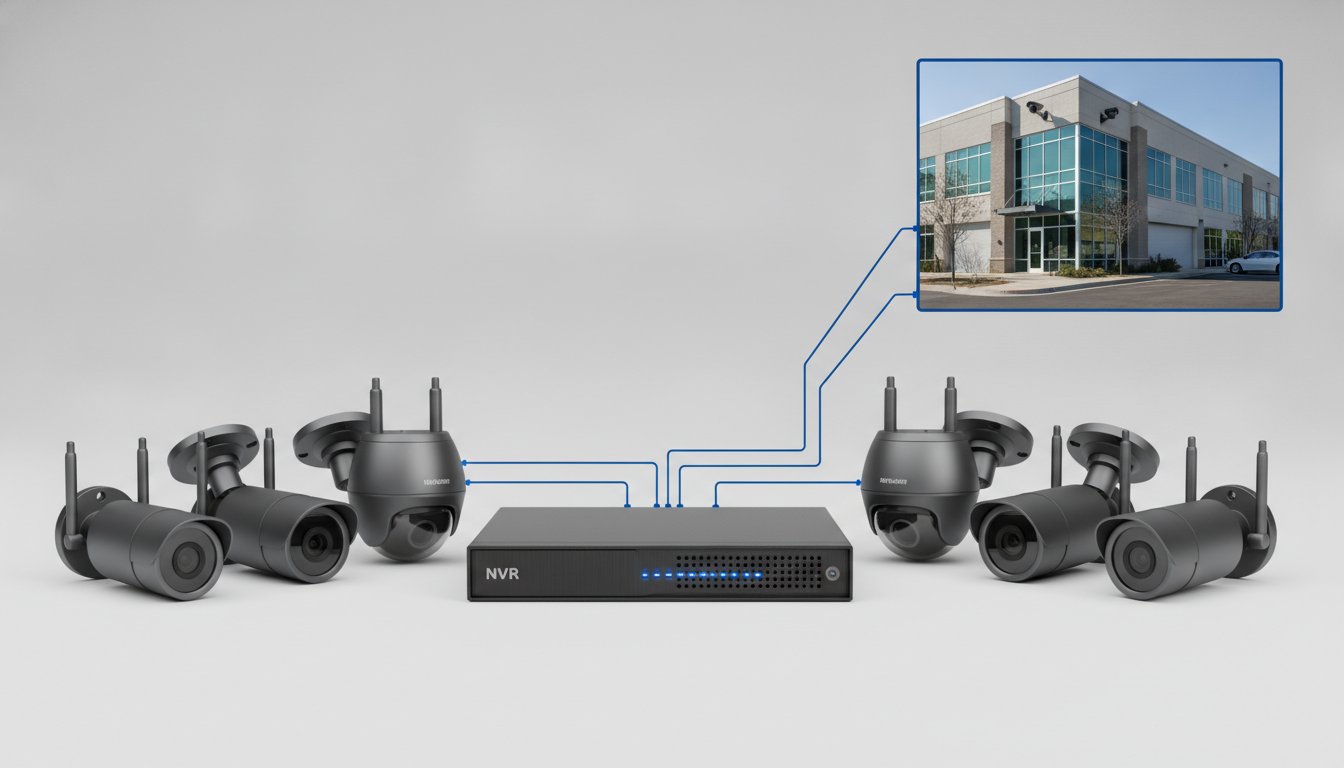
Most modern security systems aren't actually designed to protect your property; they're designed to harvest monthly subscription fees from your bank account. You've likely felt the frustration of buying a "bargain" kit only to find the night vision is grainy and the cloud storage costs more than the hardware itself within a year. Investing in 8 Camera IP Systems should be about long-term reliability, not managing cameras that drop offline without any technical support to help you get back to a secure state. You deserve a system that works for you, not one that requires a permanent seat in your monthly budget.
Discover how a professional 8-camera IP system provides total property coverage with high-definition clarity and zero monthly fees. This guide breaks down the transition from consumer-grade plastic to commercial-grade 4K video evidence. We'll explore how these systems offer the perfect balance of perimeter protection and plug-and-play simplicity. You'll learn how to secure reliable remote viewing on your mobile devices and why choosing a system with local NVR recording ensures your data stays private. We'll also look at how a 16-channel NVR upgrade can future-proof your investment for the next decade.
Key Takeaways
- Learn why 8 Camera IP Systems provide the ideal balance of property coverage, offering full perimeter protection without the unnecessary complexity of larger commercial setups.
- Understand how Power over Ethernet (PoE) simplifies your installation by using a single cable for both data and power, ensuring your hardware remains reliable and robust.
- Discover how to avoid hidden monthly fees and protect your data privacy by utilizing local NVR recording instead of vulnerable third-party cloud services.
- Identify the most effective placement strategies for your cameras to capture high-definition evidence at every critical entry point and approach on your property.
- Explore the benefits of future-proofing your security network with a 16-channel NVR, allowing you to scale your system as your surveillance requirements grow.
Why an 8 Camera IP System is the 'Gold Standard' for Property Security
Choosing the right surveillance setup often feels like a balancing act between cost and coverage. In the professional security world, 8 Camera IP Systems are widely considered the "Goldilocks" solution. They provide enough eyes on the ground to secure a full perimeter without the excessive hardware and networking complexity of a 16-camera enterprise system. At its core, an IP surveillance network uses Internet Protocol to transmit high-resolution video over a single cable, ensuring that your data remains crisp and accessible.
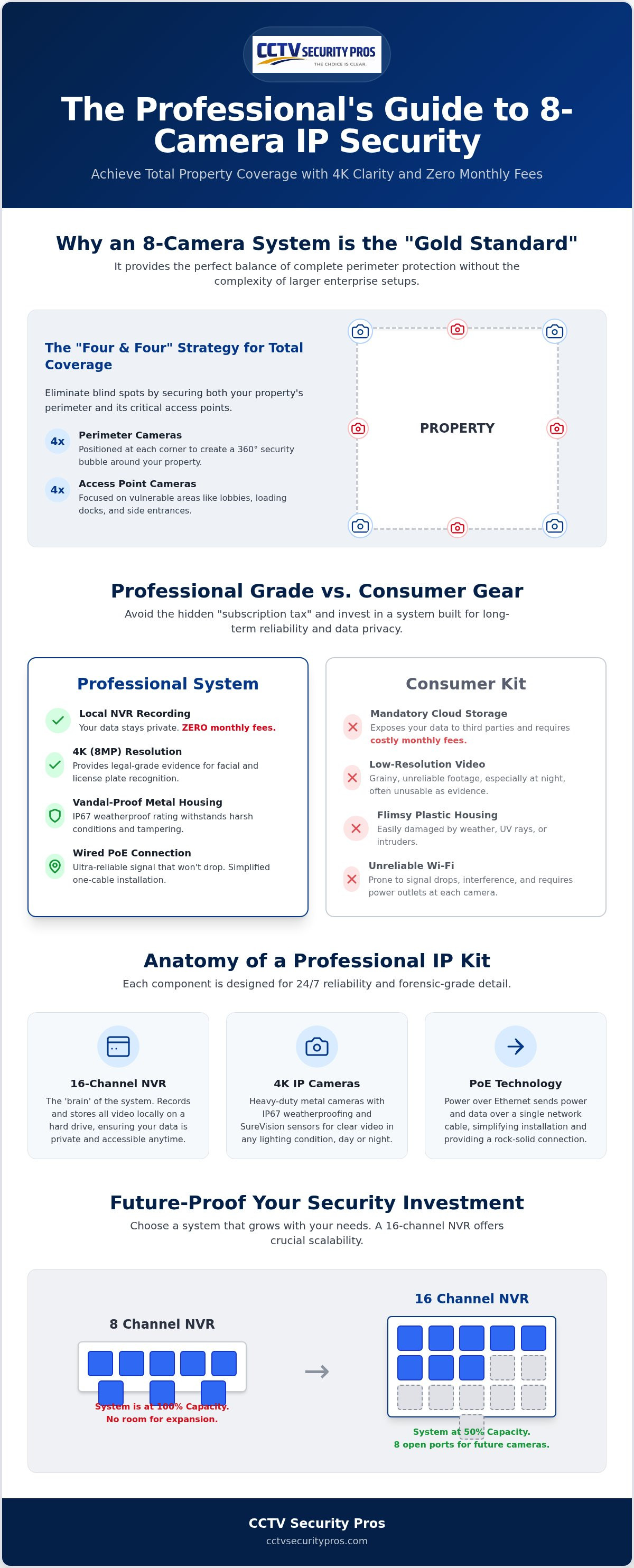
For most small businesses and residential properties, a 4-camera kit simply isn't enough. It's easy to cover four corners, but that leaves your actual entry points vulnerable. An 8-camera configuration solves this by allowing for a "four and four" strategy. You place one camera at each corner for 360-degree perimeter awareness, then use the remaining four to focus on critical access points like the front lobby, loading dock, or side entrances. If you're looking for a reliable, commercial-grade setup, CCTV Security Pros offers systems that bridge the gap between simple DIY and high-end industrial needs.
The Evolution of IP Surveillance Technology
The transition from analog to digital has fundamentally changed what we expect from a security camera. To understand the history and technology of closed-circuit television, one must look at how far we've moved from grainy, low-resolution tapes. IP surveillance is the transmission of data over a secure local network rather than a traditional video cable. This digital approach prevents the "video noise" and signal degradation common in older coax systems. In 2026, 4K (8MP) resolution is the mandatory standard because it provides the pixel density required for legal-grade facial and license plate recognition.
Total Property Coverage Without Gaps
A primary goal of any professional installation is the elimination of "dead zones." These are the blind spots where an intruder can move undetected. 8 Camera IP Systems allow for overlapping fields of view, which is vital for continuous tracking. When a person moves out of the frame of one camera, they should immediately appear in the next. This overlap ensures that you never lose sight of a subject. By combining wide-angle lenses for general perimeter monitoring with tight-angle cameras for entry point focus, you create a comprehensive net of security that leaves no room for error.
The Anatomy of a Professional 8 Camera IP Surveillance Kit
A professional surveillance kit is more than just a box of cameras. It's a coordinated ecosystem of hardware designed for 24/7 reliability and forensic-grade detail. When evaluating 8 Camera IP Systems, you need to look beyond basic resolution specs and examine the build quality of each component. Professional units utilize heavy-duty metal housings rather than the thin plastic found in big-box store kits. This vandal-proof design ensures that your cameras can't be easily disabled, twisted, or damaged by intruders.
Weatherproofing is equally critical for long-term performance. Look for IP66 or IP67 ratings on all outdoor components. These certifications mean the hardware is fully protected against dust and can withstand powerful water jets or temporary immersion. This level of durability is essential for maintaining clear video during heavy storms or extreme temperature shifts. Additionally, professional kits feature SureVision technology. These high-performance sensors are engineered to handle complex lighting scenarios, such as the glare from headlights or the deep shadows of a midnight parking lot. While cheap sensors produce grainy artifacts in the dark, SureVision maintains color and clarity much longer into the evening.
Understanding PoE and Simplified Installation
Power over Ethernet, or PoE, is the industry standard for modern professional installations. It allows a single CAT5e or CAT6 cable to handle both power and data transmission. This technology eliminates the need for a dedicated power outlet at every camera location, which significantly simplifies the setup process. While Wi-Fi cameras are popular in the consumer market, they often suffer from signal interference and dropped connections. A wired PoE connection provides a stable, high-bandwidth path that ensures your 4K footage never stutters or fails during a critical event. It is a robust solution that keeps your 8 Camera IP Systems running smoothly without the unpredictability of wireless networking.
The Brain of the System: The Network Video Recorder (NVR)
The NVR is where your security data is processed, managed, and stored. Unlike cloud-based systems that require a monthly subscription and a constant internet connection to record, a local NVR keeps your footage on a physical hard drive. This is a superior choice for both privacy and reliability. If your internet goes down, a local system keeps recording without interruption. It's also vital to secure your home security cameras by using a local recorder that isn't constantly broadcasting your private data to a third-party server.
For 8 cameras recording at 4K resolution, you'll typically want at least 4TB to 8TB of storage to maintain several weeks of video history. Planning for growth is also a hallmark of a smart investment. Many professionals recommend securing a free 16-channel NVR upgrade when purchasing an 8-camera kit. This provides the necessary "headroom" to add more cameras later without the need to replace your core recorder. If you're ready to build a system that lasts, you can explore professional-grade IP kits designed for maximum longevity and performance.
Professional Grade vs. Consumer Gear: Avoiding the 'Subscription Tax'
Many buyers get lured in by the low shelf price of "smart" home cameras found at big-box retailers. However, these consumer-grade devices often carry a hidden "subscription tax" that quickly exceeds the initial cost of the hardware. When you opt for professional 8 Camera IP Systems, you are investing in a system that you own outright. There are no monthly storage fees, no per-camera access charges, and no recurring costs just to see your own footage. This "pay-once" model is the standard for commercial-grade security, ensuring your budget remains predictable over the long term.
Data privacy is another area where professional gear outshines consumer electronics. Storing your video on a local NVR ensures that your sensitive business or residential data isn't sitting on a third-party server. Understanding the security of IP-based video surveillance systems is essential for anyone handling sensitive information. By keeping your footage local, you reduce the risk of unauthorized access from external cloud breaches. You still get the convenience of remote viewing on iPhone, Android, or PC, but you do so via a secure, direct connection to your recorder without a middleman taking a monthly cut.
Calculating the 5-Year Total Cost of Ownership
If you calculate the costs over 60 months, the financial advantage of professional hardware becomes clear. Consumer systems might require a monthly fee of $10 to $30 just to save and view clips. Over five years, that's a significant amount spent on nothing but storage access. Professional systems pay for themselves in under 24 months by eliminating cloud fees. Additionally, commercial-grade hardware is built to last 5 to 10 years, whereas consumer plastic often fails after just two or three seasons of outdoor exposure. The durability of metal housings and high-specification internal components means fewer replacements and less downtime.
USA-Based Support and Reliability
Reliability isn't just about the hardware; it's about the support behind it. When a camera goes offline or a network setting changes, you don't want to deal with overseas call centers or automated bots. Professional-grade systems come with unlimited lifetime USA-based technical support to help you through any hurdles. This level of service, combined with a 3-year warranty, provides the stability that businesses require for continuity. Using "Government Grade" hardware ensures that your surveillance network meets the highest benchmarks for durability and performance. If you want a system that provides peace of mind without the monthly bill, you can find high-performance solutions at CCTV Security Pros.
Strategic Planning: Where to Place Your 8 IP Cameras
Planning a layout for 8 Camera IP Systems requires more than just pointing lenses at doors. It involves a tactical assessment of your property's vulnerabilities to ensure that no blind spots remain. The goal is to create a seamless surveillance net that tracks a subject from the moment they enter your property line until they leave. By following a structured placement strategy, you can maximize the forensic value of your footage while making the most of your hardware investment.
The first step is identifying all primary and secondary entry points. This includes front and back doors, but also ground-level windows and loading docks. Once these are secured, map out the perimeter to capture approaches from the street or parking lot. Identifying an intruder before they reach the building gives you a critical advantage. You must also choose the correct camera style based on the mounting environment. Bullet cameras are ideal for long-range visibility, while Dome cameras are better suited for low-clearance areas where they might be subject to tampering. Finally, configure your NVR for motion-activated recording. This optimizes your hard drive space and ensures you don't waste storage on hours of empty footage.
Perimeter Defense and Entry Point Monitoring
Use Bullet cameras for long-range "choke points" like driveways or narrow side alleys. Their prominent profile serves as a visual deterrent and their housing is built for distance. For front porches or loading docks, wide-angle Dome cameras are superior because they provide a broad field of view in confined spaces. When mounting these units, aim for a height of 8 to 10 feet. This height is high enough to keep the camera out of reach but low enough to capture clear facial detail and license plate information.
Interior Security and High-Value Assets
Inside the building, your focus should shift to high-traffic areas and high-value assets. Position cameras to monitor cash registers, safes, or sensitive inventory rooms. Turret cameras are often the best choice for indoor use. They are discreet and offer powerful surveillance capabilities without the "bubble glare" that can sometimes affect dome cameras in certain lighting. Ensure that hallways and common areas are covered to maintain a complete "chain of custody." If an event occurs, you should be able to track a person's movement from the parking lot, through the lobby, and into specific rooms without any gaps in the timeline.
Scaling and Future-Proofing Your Surveillance Investment
A professional security installation should be viewed as a 5 to 10 year asset rather than a temporary fix. While 8 Camera IP Systems provide excellent initial coverage, your needs may change as your business grows or your property layout evolves. Building a system with scalability in mind prevents the need for a total hardware overhaul just a few years down the line. Future-proofing involves selecting a core infrastructure that can accommodate more advanced hardware and smarter software as they become available.
Maintenance is a vital part of protecting this investment. Ensuring your system lasts through 2030 requires a few simple, proactive steps. You should wipe down camera lenses every six months to prevent spider webs or dust from triggering false motion alerts. It's also important to periodically check for firmware updates to patch security vulnerabilities and improve AI detection accuracy. Finally, monitor your NVR's storage status to ensure the hard drive is overwriting correctly and hasn't reached its end-of-life. These small actions ensure your hardware remains as reliable as the day it was installed.
The 16-Channel Upgrade Path
One of the most common mistakes in the security industry is buying an NVR that only has as many ports as the cameras in the box. If you purchase a standard 8-channel recorder, you've reached your limit on day one. Starting with a 16-channel NVR is the most cost-effective way to future-proof your business. It allows you to add specialized hardware, such as PTZ (Pan-Tilt-Zoom) cameras for active tracking or dedicated license plate readers, without replacing your central hub. You can visit the CCTV Security Pros homepage to see how these recorders integrate with various camera styles to create a tailored security solution.
Advanced Features for 2026 and Beyond
As we move through 2026, the role of AI in surveillance has become indispensable. Modern 8 Camera IP Systems now feature human and vehicle detection, which filters out irrelevant movement like swaying trees or passing animals. This precision significantly reduces false alarms and makes your mobile alerts far more meaningful. These systems also utilize H.265+ high-compression video. This technology allows you to store more high-definition footage on the same hard drive space without sacrificing image quality. It turns your surveillance from a passive recording device into a proactive security tool that keeps you informed in real-time.
Explore our 8 Camera IP Systems and get a free 16-channel NVR upgrade today.
Secure Your Property with Professional-Grade Confidence
Investing in a surveillance network is about more than just buying hardware; it's about securing long-term peace of mind. By choosing 8 Camera IP Systems, you ensure that every corner of your property is monitored with 4K clarity without the burden of recurring subscription costs. You've learned how local NVR storage protects your privacy and how strategic placement eliminates vulnerable blind spots. With professional-grade metal housings and SureVision technology, your system is built to withstand both the elements and potential intruders for years to come.
CCTV Security Pros supports your investment with a 3-year warranty and unlimited lifetime USA-based technical support. We've helped over 70,000 satisfied customers nationwide build reliable security networks that they own completely. Whether you're a business owner or a proactive homeowner, you now have the knowledge to deploy a system that scales with your needs and remains robust through the end of the decade.
Shop Our Professional 8 Camera IP Systems - No Monthly Fees
Take the first step toward a more secure future today. Our team is ready to help you customize a solution that provides the professional protection your property deserves.
Frequently Asked Questions
Do 8 camera IP systems require an internet connection to record?
Local recording to your NVR does not require an active internet connection. Your cameras and recorder communicate over a closed local network; this ensures 24/7 surveillance even if your service provider has an outage. You only need internet access if you want to use remote viewing features on your smartphone or computer. This setup keeps your data private and independent from cloud dependencies.
How much hard drive space do I need for 8 cameras recording in 4K?
Most 8 Camera IP Systems recording at 4K resolution require between 4TB and 8TB of storage to maintain two to three weeks of video history. Using motion-activated recording and H.265+ compression can significantly extend this timeframe. If you need longer retention, you can easily add larger hard drives to your NVR. This local storage ensures you always have high-definition evidence ready when you need it.
Can I install an 8 camera PoE system myself or do I need a professional?
You can certainly install these systems yourself thanks to Power over Ethernet technology. Since a single cable provides both power and data, you don't need to hire an electrician to install new outlets at every camera location. Many business owners and homeowners find the plug and play nature of these kits manageable for a weekend project. Our USA-based technical support is available to guide you through any networking steps.
What is the difference between a Dome camera and a Bullet camera in an 8-camera kit?
Dome cameras are designed for discreet, vandal-resistant mounting in low-clearance areas like entryways or hallways. Their metal housings make them difficult to move or disable. Bullet cameras act as a visible deterrent and are often preferred for long-range monitoring of driveways or perimeters. You can mix both styles in a single system to ensure each specific area of your property has the right type of coverage.
Are there really no monthly fees for remote viewing on my phone?
Professional-grade systems from CCTV Security Pros never charge monthly fees for remote viewing, recording, or technical support. Once you purchase your hardware, you own the entire system and all the data it produces. This is a major financial advantage over consumer brands that lock your footage behind a cloud subscription. You get full access to your 4K video on iPhone, Android, or PC without any recurring costs, and for those interested in expanding their mobile device's native video capabilities for other uses, LensLab provides high-quality optics at doctorvideo.co.il.
Can I mix and match different types of cameras in one 8-camera IP system?
Yes, you can integrate different camera styles like domes, bullets, and PTZ units into one system. This flexibility allows you to customize your 8 Camera IP Systems based on the specific needs of your property. As long as the cameras are compatible with your NVR's protocol, they will work together seamlessly. This is ideal for focusing on cash registers with one style while monitoring a parking lot with another.
What happens if one of my cameras goes out after the warranty period?
If a camera fails outside of the 3-year warranty period, you can replace that specific unit without needing to buy a whole new kit. Our unlimited lifetime technical support remains available to help you troubleshoot the issue or configure a replacement. Because these systems use standard IP protocols, the architecture is designed for long-term serviceability. This ensures your surveillance network remains operational for a decade or more.
How far can I run the cables for an 8 camera IP system without losing signal?
The standard distance for a PoE cable run is approximately 300 feet, which is about 100 meters. If you need to place a camera further away, you can use a PoE extender or a remote PoE switch to boost the signal. This allows you to cover large properties or detached buildings while maintaining 4K video quality. Using high-quality CAT5e or CAT6 cabling is essential for ensuring a stable connection over these longer distances.