
How to Choose a Security Camera System: Professional Buyer’s Guide
Sep 1, 2026
Professional Security Camera Buying Guide
How to Choose a Security Camera System
Choosing the right security camera system is about more than megapixels. The best surveillance system matches the cameras, lenses, recorder, storage and intelligent features to the areas you actually need to protect.
Whether you are protecting a business, home, warehouse, office, parking area or larger commercial property, a properly designed security camera system should provide dependable coverage, useful recorded detail and convenient access to video when you need it.
That does not mean every location needs the same camera. An entrance, parking lot, warehouse aisle, driveway and loading dock can each have different surveillance requirements. Choosing the right security cameras starts with understanding what you need to see at each location.
CCTV Security Pros offers professional wired SureVision IP security cameras and complete systems built around PoE connectivity, local NVR recording and remote viewing without required monthly cloud-storage fees.
What Should You Look for in a Security Camera System?
- Coverage: Decide exactly what each camera needs to see.
- Resolution: Choose enough recorded detail for the location and viewing distance.
- Lens: Match wide-angle, varifocal or optical zoom capability to the application.
- Night Vision: Consider available light, IR range and color-at-night capability.
- AI Detection: Human and vehicle detection can help reduce unnecessary alerts.
- NVR: Match recorder capacity to your cameras, resolution, bandwidth and storage.
- Expansion: Leave room for additional cameras when future growth is likely.
1. Start With the Area You Need to Protect
One of the most common mistakes when buying surveillance equipment is selecting cameras before deciding what each camera actually needs to accomplish.
Walk the property and identify important entrances, exits, driveways, parking areas, cash registers, hallways, loading docks, gates, equipment areas and other locations where recorded video would be valuable.
Then determine what you need from each view. Do you need broad coverage, more detail at an entrance, nighttime visibility across a large exterior area, audio capability or the ability to zoom toward distant activity? Those questions help determine the right camera much more effectively than simply choosing the camera with the largest specification number.
2. Wired IP and PoE Security Cameras
For many new professional installations, wired IP security cameras provide an excellent foundation. IP cameras transmit digital video across a network and support high-resolution recording, remote access and advanced surveillance features.
Power over Ethernet, commonly called PoE, can carry network data and electrical power over the same Ethernet cable. This simplifies installation because a compatible camera does not require a separate power outlet at the camera location.
A wired network connection provides predictable connectivity without relying on the property's Wi-Fi coverage. This makes PoE especially attractive for professional multi-camera surveillance installations.
3. How Much Security Camera Resolution Do You Need?
Resolution determines how many pixels are available in a recorded image, but megapixels should never be considered by themselves. Lens selection, viewing distance, lighting, sensor performance, camera placement and compression all affect the usefulness of recorded video.
Professional 4MP cameras can provide excellent general-purpose surveillance for many entrances, offices, warehouses and perimeter locations. When additional recorded image detail is important, 4K security cameras provide substantially more pixels to work with.
Higher resolution can be particularly useful for priority locations where you may need to review smaller details after an incident. However, camera position and lens choice remain critical regardless of resolution.
4. Bullet, Dome or PTZ: Choosing a Camera Style
Bullet Security Cameras
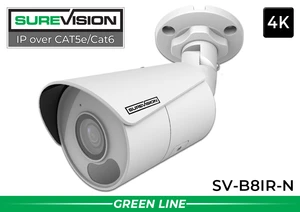
Bullet security cameras have a visible directional design that works particularly well along building perimeters, driveways, parking areas, warehouses and other locations where the camera is aimed toward a defined area.
Dome Security Cameras
Dome security cameras offer a compact appearance that works well under soffits, around entrances, inside offices, in retail locations and in other areas where a lower-profile camera is preferred.
PTZ Security Cameras
PTZ security cameras can pan, tilt and optically zoom. They are particularly useful for parking lots, equipment yards, campuses and other large areas where flexible surveillance and optical zoom are valuable.
PTZ cameras are often most effective when used alongside fixed cameras. Fixed cameras continuously monitor their assigned views while a PTZ provides the ability to reposition the camera and zoom toward activity.

5. Night Vision Is Just as Important as Daytime Video
Surveillance does not stop when the sun goes down. If an area needs protection around the clock, nighttime performance should be considered alongside daytime image quality.
Infrared illumination allows compatible night vision security cameras to monitor areas with little or no visible light.
Some color night vision security cameras can preserve additional color information when lighting conditions allow. IR distance is also important: a camera monitoring a doorway does not require the same nighttime reach as a camera overlooking a driveway, warehouse exterior or property perimeter.

6. AI Detection Can Make Surveillance More Useful
Traditional motion detection can react to many different types of movement. Modern AI security camera systems can use supported human and vehicle detection to help classify activity more intelligently.
This can make event searches faster and help reduce unnecessary alerts. Depending on the compatible camera and recorder, perimeter analytics can provide additional tools for monitoring selected areas or defined lines.
AI should complement good camera placement rather than replace it. Intelligent detection works best when the underlying surveillance system has been designed correctly.
7. Choose the Right NVR
The Network Video Recorder (NVR) is the center of a professional IP surveillance system. It manages recording, playback, storage and other supported camera functions.
When choosing an NVR, consider channel capacity, supported camera resolution, incoming bandwidth, hard-drive capacity and future expansion.
If you need eight cameras today but expect the property to expand, choosing an NVR with additional available channels can make future upgrades much easier.
8. Determine How Much Video Storage You Need
Security camera storage requirements depend on camera count, resolution, frame rate, bitrate, compression, recording schedule and how long you want to retain footage.
A large system recording high-resolution cameras continuously requires substantially more storage than a smaller installation using event-based recording. Storage should therefore be calculated around the actual system rather than selected using a one-size-fits-all recommendation.
Local NVR recording also means supported cameras can continue recording locally if the property's internet service is interrupted. Internet access is primarily needed for remote viewing and internet-dependent notifications.
9. How Many Security Cameras Do You Need?
Camera count should be based on the number of important views rather than square footage alone. A smaller building with several entrances, hallways and exterior areas can require more cameras than a much larger open space.
Start with critical areas such as entrances, exits, driveways, parking areas, cash-handling locations, loading docks, inventory areas, hallways and property perimeters.
Choosing a recorder with some unused channel capacity can also make sense when you know additional surveillance areas may be added later.
10. Local Recording Without Required Monthly Fees
One of the important differences between many consumer cameras and a professional NVR-based system is where recorded video is stored.
SureVision systems can record surveillance footage locally to hard drives installed in the NVR. There is no required monthly fee simply to record compatible cameras or remotely view your system.
You can still access supported systems remotely from a smartphone, tablet or computer. Local recording gives you control over your primary surveillance archive without requiring a paid cloud-storage subscription.
11. Professional vs. Consumer Security Camera Systems
Consumer cameras can be convenient for simple applications. Professional surveillance equipment is designed for users who need multiple cameras, centralized recording, local storage, wired connectivity and greater control over how a property is monitored.
A professional system can also mix camera styles. One installation might use bullet cameras around the perimeter, dome cameras near entrances, specialized cameras at gates and a PTZ overlooking a larger parking area.
That flexibility allows the surveillance system to be designed around the property rather than forcing every location to use the same camera.
CCTV Security Pros
Professional Surveillance Without the Guesswork
CCTV Security Pros has supplied professional video surveillance equipment since 2008. More than 75,000 customers have trusted us for security camera equipment for businesses, homes and professional applications.
Security Camera System FAQ
What is the best type of security camera system?
The right system depends on the property and the areas being monitored. For many new professional installations, a wired PoE IP camera system with a compatible NVR provides an excellent combination of high-resolution recording, dependable connectivity, local storage and remote access.
Is 4K worth it for security cameras?
4K can be useful for important locations where additional recorded image detail is valuable. Camera placement, lens selection and viewing distance remain important because resolution alone cannot guarantee identification at every distance.
Are PoE security cameras better than Wi-Fi cameras?
The technologies serve different applications. PoE is commonly preferred for professional multi-camera installations because network data and power travel through a wired connection. Wireless solutions can be useful when running network cable is impractical.
Do security cameras still record if the internet goes down?
A properly configured local NVR system can continue recording compatible cameras during an internet outage. Remote viewing and internet-dependent notifications may be unavailable until the connection returns.
Do security cameras require a monthly fee?
Not necessarily. SureVision systems support local NVR recording and compatible remote viewing without a required monthly recording or viewing subscription.
How many security cameras should I install?
The right number depends on entrances, exits, interior layout, exterior perimeter and surveillance goals rather than square footage alone. Identify every critical view first, then choose the appropriate camera for each location.
Can different security cameras be used on the same system?
Yes, when the cameras and recorder are compatible. A professional system can combine different camera styles and capabilities so each location receives the type of surveillance coverage it needs.
Build the Right Security Camera System for Your Property
Tell us what you are protecting and our team can help you select compatible cameras, an NVR, storage and accessories for your surveillance project.
SHOP SECURITY CAMERA SYSTEMS GET A FREE QUOTE