
Choosing the Right NVR for IP Cameras: Complete 2026 Guide
Aug 12, 2026
Choosing the Right NVR for IP Cameras: Complete 2026 Guide
The right NVR gives you dependable local recording, simple playback, remote viewing and room to expand—without forcing you into monthly cloud-storage fees. This guide explains how to compare NVR channels, PoE connections, camera resolution, recording bandwidth, hard-drive capacity and compatibility so you can choose the right recorder the first time.
Many homeowners and business owners pay ongoing cloud fees because local video recording appears complicated. In reality, a properly matched network video recorder can provide private, professional surveillance through a one-time equipment investment. Your video remains on a local surveillance hard drive that you control, while compatible apps and software let authorized users view cameras remotely.
The most important part is matching the recorder to the cameras and the property. An NVR must support your camera technology, total camera count, desired resolution, combined recording bandwidth and storage goals. CCTV Security Pros has helped customers design professional surveillance systems since 2008, and our team can provide free equipment guidance or a custom quote when you want help confirming the details.
Key Takeaways
- Choose an NVR made for IP or PoE security cameras—not a DVR intended for coax cameras.
- Select enough channels for every camera you need today, plus sensible room for future expansion.
- Confirm the recorder supports your cameras' resolution, video compression, incoming bandwidth and advanced features.
- Plan storage around camera count, resolution, frame rate, scene activity, recording schedule and desired retention time.
- Built-in PoE ports can simplify installation by carrying camera power and video over one Ethernet cable.
- Professionally matched equipment reduces compatibility problems and gives you local recording with no required monthly fee.
Products Featured in This Guide
SureVision NVR Recorders and Expandable Storage
These are the complete recorder and storage options currently shown in the SureVision NVR category. Click any product image, name or button to view the exact product.
 |
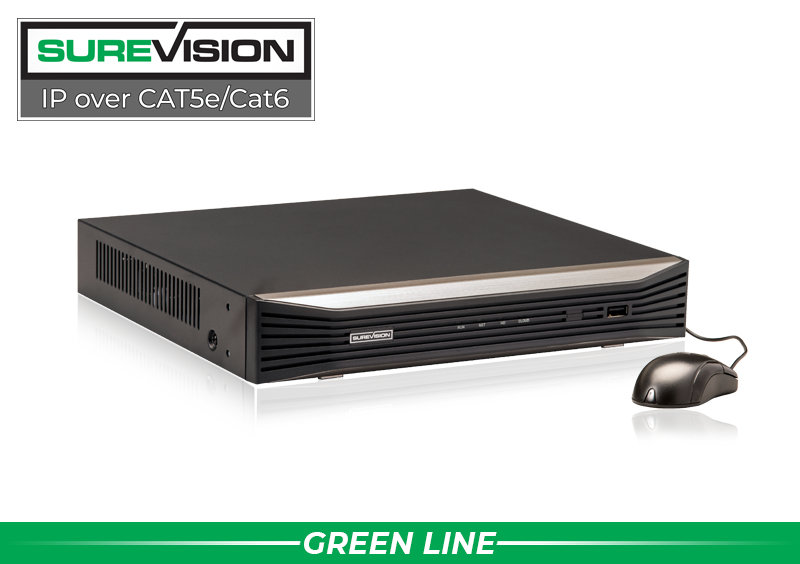
SureVision 4-Channel NVRSV-NVR1P4-N |
 |
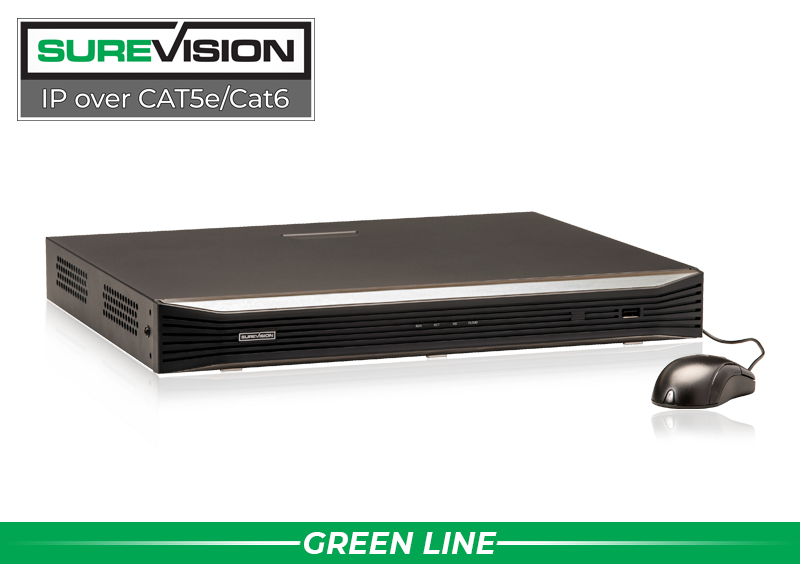
SureVision 8-Channel NVRSV-NVR1P8-N |
 |
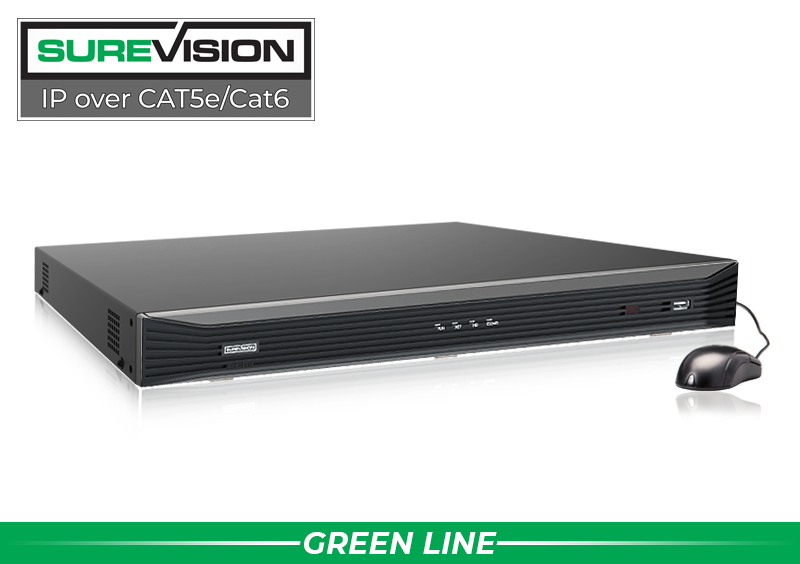
SureVision 16-Channel NVRSV-NVR2P16-N |
 |
SureVision 32-Channel NVRSV-NVR432-N |
 |
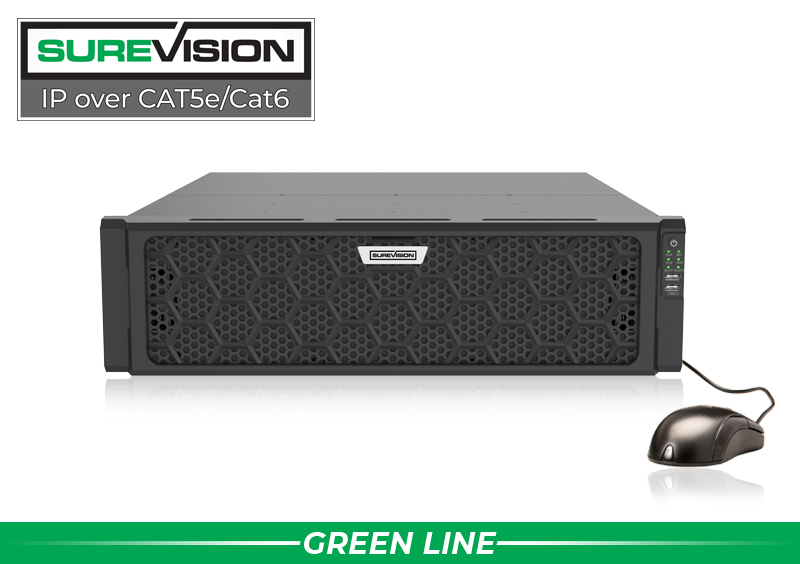
SureVision 64-Channel NVRSV-NVR864-N |
 |
SureVision 128-Channel Enterprise NVRSV-NVR128-N |
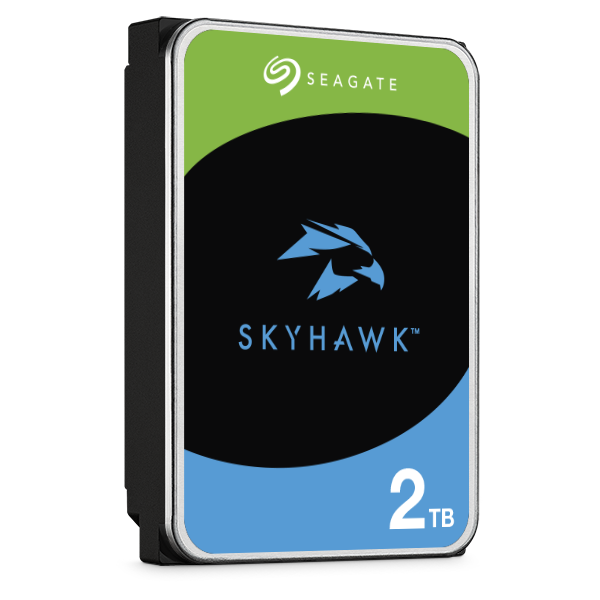 |
Surveillance Hard Drive — Select 2TB to 20TBModel CSP-HDD |
What Is an NVR for IP Cameras?
A network video recorder, usually called an NVR, is the central recording and management device in an IP security camera system. Compatible cameras create digital video streams and send them to the recorder over an Ethernet network. The NVR stores that footage on an internal hard drive and gives you one place to view live video, search recordings, export evidence, manage recording schedules and configure supported alerts.
Unlike a cloud-only camera, a professional NVR stores video locally. Recording can continue even if the property's internet service goes down, provided the recorder, cameras and local network still have power. Internet service is generally needed only for off-site remote viewing, app notifications and other online features.
You can compare current SureVision NVR recorders for IP cameras or read the broader Ultimate Guide to Network Video Recorders for more background on how NVR recording works.
NVR vs. DVR: Which Recorder Do You Need?
The correct recorder is determined primarily by your camera technology and wiring. An NVR is designed for digital IP or PoE cameras that communicate over Ethernet. A DVR is generally designed for compatible HD-over-coax cameras connected with coaxial cable and BNC connectors.
| Comparison | NVR | DVR |
|---|---|---|
| Camera type | IP and PoE security cameras | HD-over-coax and compatible analog cameras |
| Common wiring | CAT5e or CAT6 Ethernet cable | Coaxial cable with BNC connectors |
| Best fit | Most new professional wired installations | Properties reusing compatible coax wiring |
| Camera power | Often supplied through PoE | Usually supplied separately |
| Expansion | Flexible when channels, bandwidth and network capacity are planned correctly | Dependent on available BNC inputs and existing wiring |
If you are unsure which technology your existing cameras use, review our complete DVR vs. NVR comparison before ordering. Buying an NVR does not automatically make an existing coax camera compatible.
How to Determine Your NVR Requirements
Choosing a recorder is about more than matching the number printed on the box. The NVR must be able to receive, process, display and store every connected camera stream while supporting the features you expect to use.
Use This NVR Buying Checklist
- Camera technology: Confirm every camera is an IP camera and determine whether it uses PoE.
- Channel count: Count the cameras being installed now and the cameras you may add later.
- Resolution: Confirm the NVR supports the recording resolution of each camera, including 4MP, 4K or higher-resolution models.
- Incoming bandwidth: Make sure the recorder can handle the combined bit rate of all connected cameras.
- Storage: Estimate the hard-drive capacity required for the number of days you want to retain footage.
- PoE layout: Decide whether cameras will connect directly to built-in NVR PoE ports or through one or more network PoE switches.
- Feature compatibility: Verify support for audio, PTZ control, smart motion detection, intrusion rules, remote viewing and any other feature important to you.
- Hard-drive bays: Check how many drives the NVR accepts and the maximum supported capacity per drive.
- Display and playback: Confirm monitor outputs and simultaneous playback capabilities meet your needs.
- Support and warranty: Choose equipment backed by knowledgeable help before and after the sale.
Choosing the Right NVR Channel Count
Each NVR channel supports one camera. A 4-channel NVR supports up to four compatible cameras; an 8-channel NVR supports up to eight; and the same principle applies to 16-, 32-, 64- and larger channel models.
We generally recommend leaving room to grow. If you need six cameras today, an 8-channel NVR may be sufficient. If you expect to add several entrances, parking views or interior cameras, the SureVision 16-channel NVR may be the better long-term investment. Planning ahead can prevent you from replacing the recorder as soon as the property needs more coverage.
| NVR Size | Typical Use | Planning Consideration |
|---|---|---|
| 4 channels | Focused home, office or small-area coverage | Limited expansion room once four cameras are installed |
| 8 channels | Homes, small stores and compact businesses | Good when the final plan is eight cameras or fewer |
| 16 channels | Retail, offices, restaurants, larger homes and warehouses | Useful expansion capacity for growing systems |
| 32 channels | Large commercial properties, schools and multi-zone facilities | Four drive bays and RAID options support larger storage plans |
| 64 channels | Enterprise, government and multi-building surveillance | Eight drive bays provide significant local-storage capacity |
| 128 channels | Campuses, major facilities and mission-critical deployments | Sixteen drive bays, advanced RAID and enterprise redundancy |
Shop SureVision NVRs by Channel Capacity
Choose the recorder that fits your camera count today while leaving practical room for future expansion. Every product image below is the exact SureVision product shown on its linked product page.
SureVision 4-Channel NVR
SV-NVR1P4-N
Focused homes, offices, storefronts and systems with up to four IP cameras.
SureVision 8-Channel NVR
SV-NVR1P8-N
Growing homes, retail stores, restaurants and small businesses with up to eight cameras.
SureVision 16-Channel NVR
SV-NVR2P16-N
Businesses needing 16 PoE ports, dual-drive storage support and room to expand.
SureVision 32-Channel NVR
SV-NVR432-N
Commercial sites needing 32-camera capacity, four drive bays and RAID support.
SureVision 64-Channel NVR
SV-NVR864-N
Enterprise and government projects needing eight drive bays and advanced RAID options.
SureVision 128-Channel NVR
SV-NVR128-N
Flagship recorder for campuses and major facilities, with 16 drive bays and enterprise RAID.
Availability can change. Check each product page for current stock status and configuration options.
For a practical example of planning beyond a small installation, see our guide to scaling up to a 16-camera security system. You can also compare complete 16-camera IP security camera systems with cameras, NVR and storage already matched.
Resolution, Bandwidth and Camera Compatibility
Match the NVR to Your Camera Resolution
A camera's maximum resolution does not matter if the recorder cannot support it. When using 4K IP security cameras, confirm that the NVR supports 4K recording—not only 4K monitor output. These are different specifications. Also check how many high-resolution streams can be displayed or played back simultaneously.
Understand Incoming Bandwidth
Every camera sends a video stream with a particular bit rate. The NVR's incoming bandwidth must be high enough to receive all streams at the same time. Resolution, frame rate, compression, image complexity and quality settings all influence each camera's bit rate. A system may have enough physical channels but still be improperly sized if the total bandwidth requirement exceeds the recorder's capacity.
ONVIF Helps, but Does Not Guarantee Every Feature
ONVIF compatibility can help products from different manufacturers communicate, but it does not guarantee that every advanced feature will work across brands. Basic live video may connect while audio, smart analytics, motion events, PTZ controls or configuration tools remain limited. Matching cameras and NVRs from the same supported product family is usually the safest route when you want full functionality.
If you are adding cameras to an existing recorder, browse SureVision IP security cameras and contact our team before ordering so we can confirm model-level compatibility.
How Much NVR Storage Do You Need?
NVR storage is measured in terabytes, but there is no single number of recording days that applies to every system. Retention time depends on:
- Number of connected cameras
- Resolution and bit rate of each camera
- Frames recorded per second
- H.264, H.265 or other supported compression settings
- Continuous, scheduled or motion/event-based recording
- Amount of activity and visual detail in each scene
- Audio recording and other enabled data streams
- Number of days footage must be retained
Motion Recording vs. Continuous Recording
Motion or event recording can extend retention by saving video primarily when activity occurs. It works well when analytics are configured properly and the scene does not contain constant motion. 24/7 continuous recording creates a complete timeline but consumes storage more quickly. Many businesses choose continuous recording for critical entrances, registers or high-liability areas and event-based recording for lower-traffic locations.
Modern compression such as H.265 can reduce storage and bandwidth use compared with older compression when supported and configured correctly. However, compression does not eliminate the need to size the drive for your actual camera count and retention goal.
Surveillance Hard Drives for NVRs and DVRs
Add or upgrade local storage with a surveillance-grade Seagate SkyHawk hard drive built for continuous camera recording. Select the capacity that matches your camera count, resolution and desired retention period.
Shop Surveillance Hard DrivesBuilt-In PoE NVR vs. an External PoE Switch
A PoE NVR has built-in Power over Ethernet ports. Each compatible camera can connect directly to the recorder with one CAT5e or CAT6 Ethernet cable that carries both power and video. This direct connection is popular for small and medium-sized installations because it simplifies wiring, camera discovery and troubleshooting.
Larger properties may place cameras far from the recorder or group them in separate areas. In those layouts, one or more external PoE switches may be more practical. The cameras connect to the nearest switch, and the network carries their video back to the NVR. This approach requires more network planning, but it can reduce long cable runs and make expansion easier.
Learn more about PoE security cameras and one-cable installation, compare PoE switches and power equipment, or shop security camera cables and connections for a complete installation.
Step-by-Step Guide: Selecting and Setting Up Your NVR
Before You Buy
- List every current camera model, resolution and required feature.
- Map the camera locations and decide whether they will connect directly to the NVR or through PoE switches.
- Choose a channel count with appropriate room for expansion.
- Confirm resolution support and combined incoming bandwidth.
- Calculate storage from the desired retention period and recording schedule.
- Check the number of hard-drive bays, supported drive sizes, display outputs and remote-viewing options.
- Verify compatibility before ordering replacement or mixed-brand equipment.
Bench-Test the System Before Installation
Connect the NVR, monitor and cameras on a table before mounting cameras or pulling final cable runs. A bench test lets you confirm that every camera powers on, displays video and supports the expected features while the equipment is easy to reach.
- Connect the NVR to a monitor and follow the initial setup prompts.
- Connect each camera and confirm that it appears on the correct channel.
- Initialize or format the surveillance hard drive through the recorder menu.
- Set the date, time, recording schedule and desired video-quality settings.
- Configure supported motion or human/vehicle detection to reduce unwanted alerts.
- Connect the NVR to your router if you want off-site remote viewing.
- Install the compatible mobile app or desktop software and test live view and playback.
- Change default passwords and create separate authorized user accounts where appropriate.
- Test recorded playback and export a short video clip before completing installation.
For a visual explanation of the complete signal path, read how an NVR and PoE security camera system works. If you prefer cameras, recorder, hard drive and accessories selected together, compare our complete IP and PoE security camera systems.
Need Help Matching an NVR to Your Cameras?
Tell us your camera models, camera count, desired recording time and expansion plans. Our U.S.-based team will help you choose a compatible recorder and practical storage configuration.
Shop SureVision NVRs Call 888-653-2288Maximizing Your Investment with Professional NVR Hardware
A network video recorder is expected to process and write video around the clock. Professional hardware is designed for this continuous workload and gives you better control over recording schedules, playback, evidence export, authorized users and system expansion. The goal is not simply to capture video; it is to retrieve clear, usable footage when an incident occurs.
The SureVision Difference
SureVision recorders provide local hard-drive recording, compatible remote viewing and professional system management without a required monthly cloud-storage subscription. Supported models offer features such as high-resolution recording, motion and event tools, perimeter protection, intrusion detection, H.265 compression and expandable storage. Exact capabilities vary by recorder and camera model, which is why compatibility should be confirmed before purchase.
You can build a custom solution with individual cameras and a recorder or start with a professionally matched system, such as an 8-camera IP security camera system. Matching the equipment from the beginning usually makes installation, configuration and long-term support easier.
Why U.S.-Based Support Matters
Networking, app setup and storage calculations can create questions even when the physical installation is straightforward. CCTV Security Pros provides unlimited U.S.-based support to help customers choose, install and use compatible equipment. Our professional products are backed by a three-year warranty, and our team is available before and after the sale.
For more help designing the complete solution—not only the recorder—visit our Ultimate Guide to Security Camera Systems.
Frequently Asked Questions About NVRs for IP Cameras
Can I use any IP camera with any NVR?
No. Cross-brand compatibility is not guaranteed. ONVIF can make basic communication possible between supported products, but advanced functions such as smart analytics, audio, PTZ control, motion events and camera configuration may not work fully. Confirm the exact camera and NVR models before buying.
Do I need internet service for an NVR to record?
No. A properly configured NVR can record compatible cameras to its local hard drive without internet service. Internet access is generally required for remote viewing outside the property, app alerts, time synchronization and other online features.
What is the difference between a PoE NVR and a non-PoE NVR?
A PoE NVR includes built-in ports that can provide power and network connectivity to compatible cameras through one Ethernet cable. A non-PoE NVR requires the cameras to receive power and network connectivity through external equipment, commonly a PoE switch.
How many NVR channels do I need?
Select at least one channel for every camera you plan to connect. If future expansion is likely, choose additional capacity now. For example, a six-camera installation may use an 8-channel NVR, while a growing business may benefit from moving directly to a 16-channel recorder.
How many days of video will a 2TB NVR store?
There is no universal answer. Retention depends on camera count, resolution, frame rate, compression, bit rate, scene activity and whether recording is continuous or event-based. A 2TB drive will retain substantially less footage in a multi-camera 4K system than in a smaller lower-resolution system.
Can an NVR record 4K IP cameras?
Yes, if the NVR supports the camera's resolution, protocol and combined bandwidth requirements. Confirm that the recorder supports 4K recording, not only 4K display output.
Can I view my NVR remotely without a monthly fee?
Yes. Compatible SureVision NVRs support remote viewing from supported smartphones, tablets and computers without a required monthly viewing or cloud-storage subscription. The NVR must be connected to an internet-enabled network for off-site access.
What happens to recorded NVR footage during a power outage?
Previously recorded footage remains stored on the hard drive. The system cannot record new footage while the recorder or cameras are without power, but it should resume operation when power returns if configured properly. A compatible uninterruptible power supply can help keep equipment running through brief outages.
Choose the Right NVR the First Time
The best NVR for IP cameras is the one that matches your camera technology, resolution, bandwidth, storage needs and expansion plans. Choose enough channels for future growth, confirm the recorder supports every important camera feature and size the hard drive around your actual retention goal—not a generic estimate.
When you want a complete solution, CCTV Security Pros can match professional IP cameras, a compatible SureVision NVR, surveillance storage and installation accessories for your property. You receive local recording, free compatible remote-viewing tools, a three-year warranty and unlimited U.S.-based support with no required monthly fees.
Shop professional NVR recorders or call 888-653-2288 for free compatibility and storage assistance.